
Find Your Hedgehog
A study of successful individuals uncovers traits and patterns that may guide readers to their own triumphs.
At first blush, the soothingly contemplative title What to Make of a Life may leave an impression that this book is a gentle bromide to assuage older readers in their search for the meaning of it all.
This would be incorrect. Those of us who are not anywhere near the exit turnstile will also find great value in this book chock-full of insights, examples, and support for navigating choppy waters in the journey toward a purposeful life.
Many readers know Jim Collins from his ultra-bestselling book Good to Great, a mainstay in the business world for corporate leaders who desire exceptional results and growth. Conversely, What to Make of a Life guides readers to finding their highest level of personal satisfaction through a chosen profession with thoughtful steps each of us may follow. The book is the result of over a decade of study by Collins’s team of research assistants into the lives of 34 successful individuals.
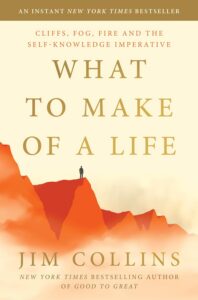
What to Make of a Life: Cliffs, Fog, Fire and the Self-Knowledge Imperative
By Jim Collins
HarperCollins Publishers
$32
At the start, Collins defines and underscores the importance of finding a person’s deep passion. He refers to this individual passion as a personal hedgehog, a line of work one is enthusiastic about and genetically suited to achieve. (Most of us will never be ballet dancers or linebackers.)
Applying a Greek parable, Collins explains that the hedgehog “knows one big thing”—rolling itself into a spiky ball to defend against a fox attack. Finding a personal hedgehog means you stay intensely focused for an extended period of time and fend off any outside distractions. “When in full hedgehog mode, the people in our study displayed an instinctive awareness of how best to tap their encodings by translating them into ways of living and working that suited the individual exceptionally well,” Collins writes. Find and know thyself.
A person may have more than one hedgehog over a lifetime, sometimes discovering and pursuing multiple hedgehogs in their advanced years. Toni Morrison discovered her hedgehog of writing fiction in her 30s. John Glenn had two hedgehogs, first as a record-setting pilot and astronaut, later as a U.S. senator. “One of my favorite findings,” Collins writes of his subjects, “is how many of them did some of their most significant and groundbreaking work well past the midpoints of their lives, sometimes well into their sixth, seventh, even eighth and ninth decades.”
Rather than discovering their hedgehogs, many people unwittingly drift into a lifetime quagmire that Collins calls the Curse of Competence Doom Loop. This is when a person is competent at something, sticks with the job because it pays well, but does not tap into his or her hedgehog and true inner happiness. Locating something deeper than your perceived strengths is about “finding what you can do exceptionally well relative to other ways you could expend yourself,” according to the book.
In telling the stories of how individuals found their hedgehogs and navigated life’s potholes and dead ends, Collins pairs individuals who shared similar journeys and life-altering events, or “cliffs,” and then compares how their reactions shaped their subsequent paths. Examples of the matched-pair approach include U.S. Presidents Gerald Ford and Jimmy Carter, Revolutionary-era patriots Benjamin Frankin and Roger Sherman, writers Morrison and Barbara Tuchman, and scientists Barbara McClintock and Grace Hopper, among many others. Collins and his researchers studied personal correspondence, articles, biographies, and published interviews on each of these subjects, amassing hundreds of thousands of pages and thousands of hours of recordings to discover patterns and traits that may explain future success or failure.
Morrison and Tuchman began work on their first books while in their 30s. For Morrison, a novelist, it was The Bluest Eye. For historian Tuchman, it was Bible and Sword. Their circumstances were quite different. Morrison worked a full-time job and was a single mother raising two boys. She woke up at 4 a.m. to write and snatched every available moment in her busy life to pen a few words, often scribbling phrases while stopped at red lights. Tuchman, meanwhile, came from a wealthy family, was married to a doctor, and wrote in a private cottage free of the stress of earning an income to survive.
But both were persistent and in love with the process of writing, their hedgehog. Morrison wrote for herself first, creating characters and stories she wanted to read. She knew how a book would end and then figured out how to get there. Tuchman wrote for her readers, always asking, will they turn the page? Both writers persisted without success for several years, pushing through what Collins refers to as “fog.”
Successful people can sit in the fog, continuing to work, without a clear map, Collins says. Fog is not the problem; rather it is the urge to escape the fog too quickly, throwing in the towel. Success, for the people profiled in this book, only arrived after years of work, long after many others would have moved on to something else. For Morrison and Tuchman, that meant persevering through misogyny in the publishing industry, lack of support from family, and years of uncertainty. As each received multiple rejection letters from publishers, they incorporated the critiques into improving and redrafting their work. Collins refers to this as simplex stepping, moving toward the next sensible small step when you cannot envision a long-term plan.
If you are looking for a simple set of straightforward rules for a successful life, What to Make of a Life is not that book. Its profiles make clear that there are many and varied paths to a successful professional career. Life and circumstances are too random for a 10-point checklist. For me, the book served as a self-check, pushing me to consider how I would react in the circumstances highlighted through the profiles. Even as I adjust my thinking, I remain confident that I found my two hedgehogs in insurance and bookselling. If you are willing to put in effort identifying your enduring strengths and discovering your hedgehog(s), digging in to do the work pursuing your passion, while being patient and incrementally persistent through periods of fog, then What to Make of a Life offers meaningful guidance on living with purpose.