A Holly Jolly Good Time
Step inside Europe’s most enchanting Christmas markets.
Christmas is still a couple months away, but it’s not too early to plan a holiday getaway.
Christmas is more than just a holiday—it’s winter wonderlands and sleigh bells, wooden nutcrackers and wrapped gifts, carol singing and Yule log burning. Most of these elements came from the same place: the Christmas markets of Europe.
Beginning in the late Middle Ages— specifically, Dresden in 1434—winter fairs started popping up across the German-speaking regions of central Europe every December. What began as a simple way to purchase the meat and provisions locals needed to survive the winter blossomed into a festive event with seasonal treats and simple crafts to purchase in anticipation of Saint Nicholas Day, a popular gift-giving holiday observed on Dec. 6. After the Protestant Reformation shifted the collective focus from saints to Christ, the events became known as Christkindlmarkts, German for “Christ child markets.”
WHEN TO GO: Christmas markets are typically open from mid-November through Christmas Eve.
CURRENCY: Euro. $1 = 0.85 euros
LANGUAGE: Since the larger Christmas markets are held in high-tourist areas, English is widely understood.
COMPANIES TO CONSIDER: AmaWaterways, Avalon Waterways, Viking
In the centuries since then, Christmas markets have taken over the world. From mid-November to late December in Rome, Dublin, Copenhagen, Barcelona, Chicago, and countless other cities, historic squares and broad streets transform into pedestrian-only celebrations of seasonal bliss. At these locations, revelers gather by the thousands to stroll under fairy lights, shop at timber-framed stalls, drink steaming mugs of mulled wine, snack on roasted chestnuts or sizzling sausages, listen to white-robed choirs and booming brass bands, and buy traditional (and less-traditional) gifts.
While Christmas markets have become a global phenomenon, the largest, most historic, and most eye-popping are still in Europe, where it all started. If you have a European trip coming up this holiday season, give yourself a gift you’ll always cherish by visiting one of these magical markets.
Germany
Here, virtually every city, town, and village sets up handcrafted wooden chalets, filling the air with the aroma of sizzling bratwurst and steaming glühwein (“glow-wine,” named from the hot irons once used for mulling and not for how it makes you feel).
Held in the city’s largest square since 1628, Nuremberg’s Christkindlesmarkt attracts about 2 million visitors per year, making it Germany’s leading Christmas market. Red-and-white-blanketed stalls hum with visitors searching for authentic gifts, which are easy to find since mass-produced goods are strictly prohibited. Children race off to ride on the carousel, Ferris wheel, and steam train, while parents shop the artisan stalls for handmade prune men called zwetschgenmännle and enjoy small boots filled with glühwein.
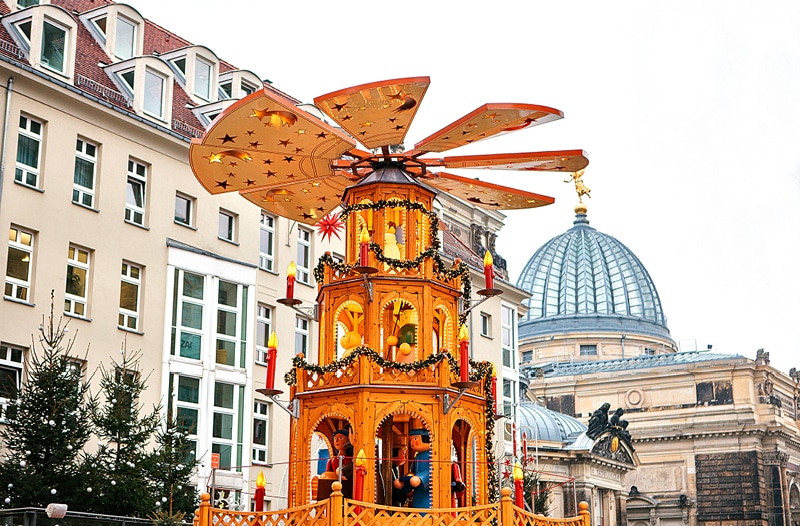
Dresden’s Striezelmarkt beats Nuremburg on age if not size. Nearly 600 years old, it’s named after the cake sold there (now commonly known as stollen), a rich, sugar-covered bread filled with dried fruit, nuts, and spices. Over the years, Dresden’s market has embraced spectacle, boasting one of the world’s largest Christmas arches at 44 feet wide, as well as the 46-foot-tall Erzgebirge Christmas pyramid, a decorative precursor of the Christmas tree.
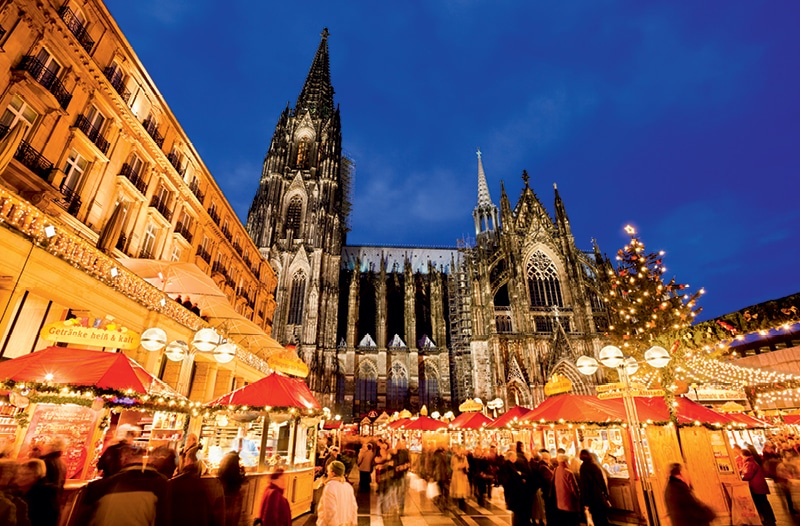
Cologne’s Cathedral Market is all about the scene. UNESCO-listed Cologne Cathedral overlooks the market square, its great Gothic spires radiantly illuminated by the brilliant, festive lights covering more than 150 stalls and a mammoth tree. Throughout the market you’ll find pewter pourers and glassblowers displaying their arts and a puppet theater in Santa’s grotto.
France
The festive wonder and giving spirit of Christmas markets spilled into France in the late 1500s, particularly in the northeastern region of Alsace.
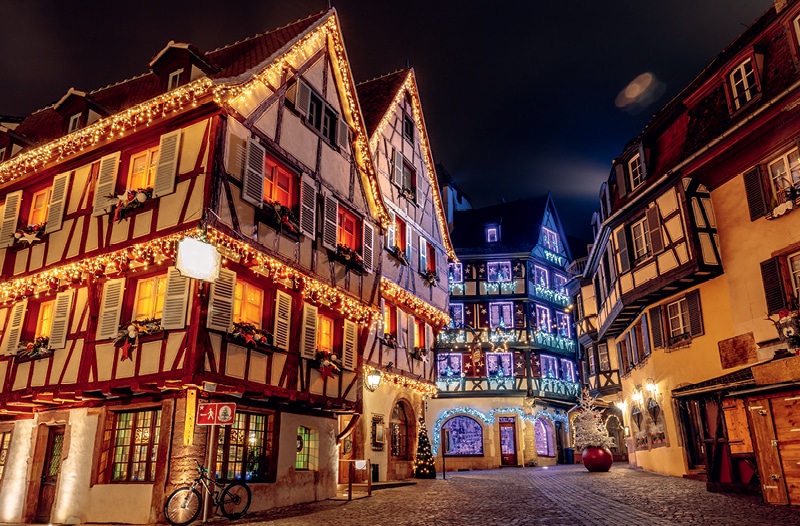
Strasbourg, widely known as the capital of Christmas, has a market dating to 1570. The festival grounds stretch across the Grande Île historic center under the backdrop of Strasbourg Cathedral, filled with hundreds of wooden chalets spread across multiple historic squares. The lighting here takes center stage at night, as the city transforms into an open-air museum of festive art complete with luminous trails connecting districts and the river Ill seemingly on fire with twinkling reflections. You’ll want to sit and admire the dazzling light show, giving you time to slowly digest all the delicious Alsatian food you consumed, including choucroute garnie, a steaming sauerkraut cooked in white wine and served with sausages and potatoes.
Also located in the Alsatian region, Colmar offers not one but six distinct markets in its remarkably preserved medieval center, all backdropped by highly decorated half-timbered houses, giving the scene an eternally jolly vibe. Colmar’s gourmet market delivers a feast, with nine chefs working out of nine cabins to serve delights such as black truffle risotto and fresh oysters.
Austria
Austria elevates the holiday season with imperial grandeur, as the markets pair crisp alpine air and snow-capped mountains with stately architecture and classical music. Case in point: Vienna’s Christkindlmarkt is set in Rathausplatz, the massive square at the famous Rathaus city hall. The whole scene is best viewed from across the square in front of the Burgtheater, Austria’s national theater, where you can ice skate through an illuminated path.
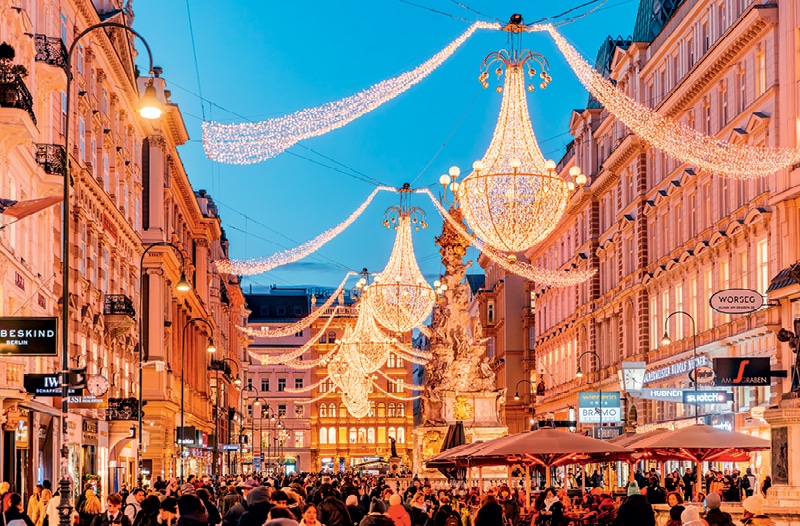
The Salzburg Christkindlmarkt sits between Domplatz (Cathedral Square) and Residenzplatz (Residence Square) in the historic heart of the city, at the foot of the Hohensalzburg Fortress. The stalls here—selling handmade ornaments, wooden toys, and nativity figurines— are connected by lighted garlands that stretch across the squares, creating a glowing canopy that looks like romantic stars suspended above the cobblestones. Traditional alpine brass bands play from the elevated balconies, creating an unforgettable soundscape as festive melodies bounce off the stone cathedral walls.
Czech Republic
The Prague Christmas markets are spread across the city, but Old Town Square is the true heart of the celebrations. The scene is bracketed by history: revelers sing along with children’s choirs and watch folk-dancing groups in traditional Czech costumes from beneath the soaring Gothic towers of the 14th-century Church of Our Lady before Týn. In the center stands a massive Christmas tree shipped from the Czech countryside, its lighting every evening accompanied by dramatic orchestral music, often the stirring “Má vlast” (“My Fatherland”) by Czech-born composer Bedrich Smetana.
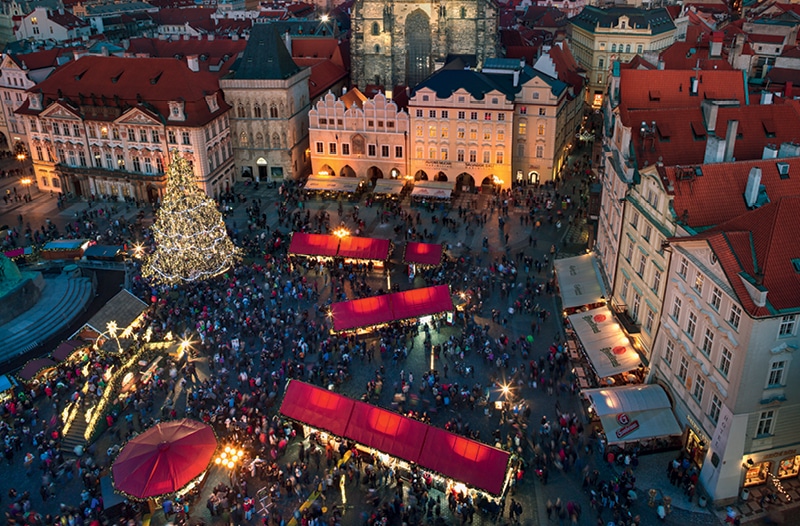
At the heart of all Christmas markets is the undeniable joy of the holidays—sharing public spaces with your community, the pleasure of eating sweets and finding gifts, and casting away winter’s darkness with a boisterous spectacle of luminescence. Yet each iteration is informed by a national identity, the important traditions kept alive, giving it a unique flavor that is a true treasure to behold.
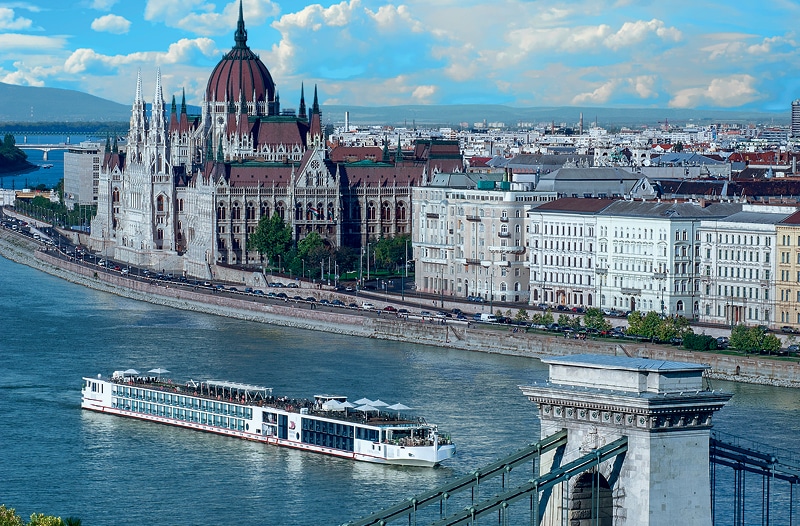
A cruise along the Danube, Main, or Rhine rivers is an excellent way to visit several of these Christmas markets in one vacation. While sailing to the likes of Strasbourg, Nuremberg, and Vienna, you can also celebrate the season in these riverside towns.
Würzburg, Germany > After touring Würzburg, a baroque gem known as the “Pearl of the Romantic Road,” head to nearby Rothenburg for the world’s most extensive collection of traditional German Christmas decorations at the Käthe Wohlfahrt German Christmas Museum.
Bamberg, Germany > Stroll past the baroque town houses that helped earn the city UNESCO World Heritage recognition before visiting dozens of nativity scenes, from miniature to life-size.
Melk, Austria > Near the magnificent Melk Abbey, the Melk Advent Market is a cozy affair filling the pedestrian zone between the Main Square and Town Hall Square.
Bratislava, Slovakia > Walk the Old Town’s cobblestone streets to Town Hall and visit the Gothic St. Martin’s Cathedral before browsing the spruce stalls of the Christmas markets.
Budapest, Hungary > The city’s Christmas market in St. Stephen’s Square is highlighted by a laser light show projected on St. Stephen’s Basilica.
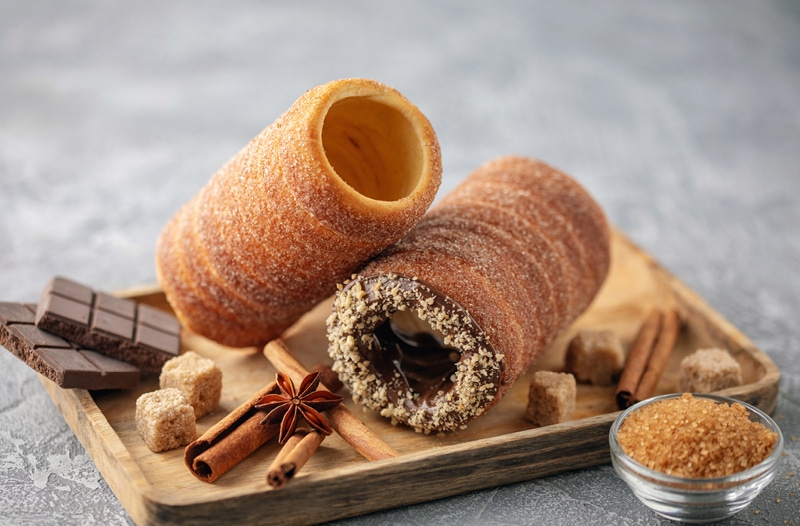
Christmas markets offer the perfect opportunity to sample traditional cuisine. From warm comfort foods for driving away the chill to sweeter treats based on traditional recipes, you will never go hungry. Here are a few must-tries.
Roasted Chestnut > “Chestnuts roasting on an open fire” are typically served hot in brown paper cones or bags to warm hands on cold winter nights.
Glühwein > This popular drink is made with hot red wine, cinnamon, cloves, star anise, lemons, oranges, and a little brandy.
Sausages > These countries take their sausages very seriously, giving each a regional twist like the spicy Nürnberger Rostbratwurst and the extra-long Thüringer Rostbratwurst.
Raclette > Heated alpine Swiss scraped off the cheese wheel and eaten with boiled potatoes, crusty baguette slices, pickles, and pickled onions.
Trdelník > Sweet dough wrapped around a spinning wooden cylinder, grilled over charcoal, and rolled in sugar, cinnamon, and crushed walnuts.