Protecting a Secular Government
Congressman Jared Huffman warns of the eroding separation of church and state as Christian nationalists seek power.
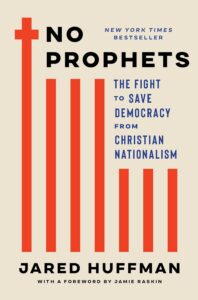
In No Prophets: The Fight to Save Democracy from Christian Nationalism, Jared Huffman offers an insider’s view as a sitting congressman of the influence of Christian nationalists in the halls of power, offering a stark warning regarding the rapidly growing threat to the separation of church and state in our democracy.
If the walls crumble between those institutions, Huffman is concerned that the U.S. Constitution will be replaced by biblical dogma as decisions are driven by prophecy rather than data, protections are eroded for non-Christians, and religious extremism breeds further violence akin to that of Jan. 6, 2021. The California Democrat’s history of the insidious and burgeoning influence of the Christian nationalist movement is compelling, deeply researched, and chilling.
No Prophets: The Fight to Save Democracy from Christian Nationalism
By Jared Huffman
W.W. Norton
$28.99
Raised in a fringe offshoot of The Church of Jesus Christ of Latter-day Saints, Huffman began doubting the existence of a god while in college after his father died of lung cancer. This was not a sudden decision, but a gradual process shaped by personal experience, observation of public affairs, and a growing sense that religious authority was being misused for political ends. He spent years in self-reflection while studying various religions.
Elected to the House of Representatives in 2012, Huffman avoided questions about his religious beliefs, or lack thereof. By 2017, he was ready to out himself at the risk of losing his Northern California congressional seat in the following election. Huffman conferred with leaders and believers in his party, along with then-Republican Rep. Adam Kinzinger of Illinois, an evangelical Christian. All supported his decision, as have Huffman’s constituents; he has been reelected to office four times with never less than 72% of the vote.
Huffman’s premise is that Christian nationalism is America’s most violent and dangerous political movement, threatening democracy and the constitutional principle of church-state separation. He asserts that its adherents promote the fallacy that end-times are coming and that religious leaders believe that God speaks directly to individuals, commanding extreme and violent behavior.
He defines Christian nationalism as the belief that Christians are entitled to privileged legal and government status and are on a holy mission to reclaim our country for Jesus Christ and God. They believe the Founding Fathers formed the United States as a Christian nation, often fabricating stories and reimagining history to recast Jefferson, Madison, Franklin, and Paine as devout Christians rather than the skeptics and deists they were.
Christian nationalism is not a single organization or movement, but rather a coalition of distinct but related movements, each with its own theological and political emphases, nevertheless all sharing the goal of placing Christians in positions of political authority. Through exhaustive research and thoughtful analysis, Huffman identifies four main spur organizations: the militant Independent Charismatic Evangelicals, autonomous evangelical leaders and ministries that promote a prophetic, confrontational political stance; The New Apostolic Reformation, whose members believe we are under siege by secular elites, including demons who must be purged by any means; the Communion of Reformed Evangelical Churches, which believes that government policy should be driven by scripture; and the Radical Traditionalist Catholics, who strictly and traditionally define Catholic teachings and believe government should adhere to those teachings. According to Huffman, these groups hope to replace parts of the Constitution with biblical doctrine while undermining public institutions such as education and scientific research by forceful, undemocratic means in a “scorched earth insurgency.”
Huffman says he witnessed Christian nationalism in action as he fortified himself alone in his Capitol Hill office on Jan. 6. The invasion of the Capitol was “a Christian coup,” according to Huffman, a militant act of terror operating in plain sight. He recalls “several large wooden crosses erected near the steps of the Capitol,” symbolic flags with the message “Jesus is My Savior and Trump is my President,” and evangelical Christians blowing shofars to signify that the “Jericho March promoted by the New Apostolic Reformation and its allies was getting underway.”
During President Donald Trump’s second term, as Huffman outlines, the movement has been given unfettered access to the halls of power. Space within Capitol buildings is set aside for Christian prayer rooms, ministers freely roam the halls offering to pray with legislators, and Defense Secretary Pete Hegseth has mandated Christian prayer sessions at the Pentagon. Huffman is concerned about the empowerment of a “shadow theocracy” within the government that will erode church-state separation and usher in Old Testament morality codes.
Huffman emphasizes in No Prophets that he is not trying to eliminate or marginalize religion in our country but wants to protect the boundaries of church-state separation so that all may worship the god of their choice, or none. In 2018, to advance this principle, he formed the Congressional Freethought Caucus in the House of Representatives; it had 37 members as of 2026. The group’s mission is to protect democracy by ensuring that legislation is respectful and inclusive of all Americans, regardless of religious faith and for those who do not participate in religion. The caucus advocates for laws to be dictated by reason and rationalism, not by any one religious screed. “The strategic importance of maintaining a united pro-democracy coalition that includes nonbelievers and secularists should be obvious: 30 percent of Americans now identify as nonreligious. ‘Nones’ are the single largest religious group in America, and we’re growing fast,” highlights Huffman.
Moving forward, Huffman advocates for working together by opposing the diversion of public funds into religious schools, challenging executive orders that attempt to restrict protected speech, and promoting legislative efforts to prevent erosion of the separation of church and state—all while embracing the principles of empathy and compassion espoused in the Sermon on the Mount.