Choosing Between Two Future States
The difference between M&A satisfaction and regret often comes down to one critical mistake: comparing today’s reality to tomorrow’s possibilities.
Most insurance brokerage sellers ultimately feel good about their decision to partner with an acquirer after the deal closes.
They have gained access to broader resources, new growth opportunities, and a clearer path to perpetuation. Yet, some sellers still experience regret as they consider the new future state of their business. Understanding the difference between these outcomes reveals what truly makes a deal successful.
In many cases, dissatisfied former owners were not fully prepared to sell in the first place. The driving force behind their decision was often valuation. Strong multiples and competitive offers can be powerful motivators, and money alone can push an owner to the table. However, a high purchase price cannot compensate for lack of readiness for what comes next.
The most common source of remorse is not financial, it is operational and cultural. Sellers who struggle after the deal closes often underestimated the magnitude of change that accompanies consolidation and integration. Processes may be different, decision-making has shifted, and autonomy is lost. Without anticipating these realities, even a financially attractive deal can feel disappointing.
A successful decision demands a disciplined comparison of two future states. Owners must evaluate what their firm will look like as part of a larger organization versus what it will look like if it remains independent. Too often, sellers make the mistake of comparing the future with a partner against the current state of their business. But the latter is not a path— it’s a snapshot in time.
A firm that is thriving today is not guaranteed to continue thriving. Market conditions shift, competition intensifies, and client expectations evolve. Remaining independent requires continued investment in talent, technology, and specialization. It also demands a clear plan for perpetuation—identifying the next generation of leadership and determining who will ultimately take ownership of the business.
Likewise, joining a buyer brings its own future state, shaped by scale, resources, and shared strategy. The decision should not hinge on which option feels most comfortable today, but on which path positions the business to compete and grow tomorrow.
Successful deals occur when sellers fully understand both futures and choose the one that gives their firm the best chance to thrive over the long term. Those who enter a transaction with clear expectations, strategic intent, and readiness for change are far more likely to look back with satisfaction rather than regret.
M&A Market Update
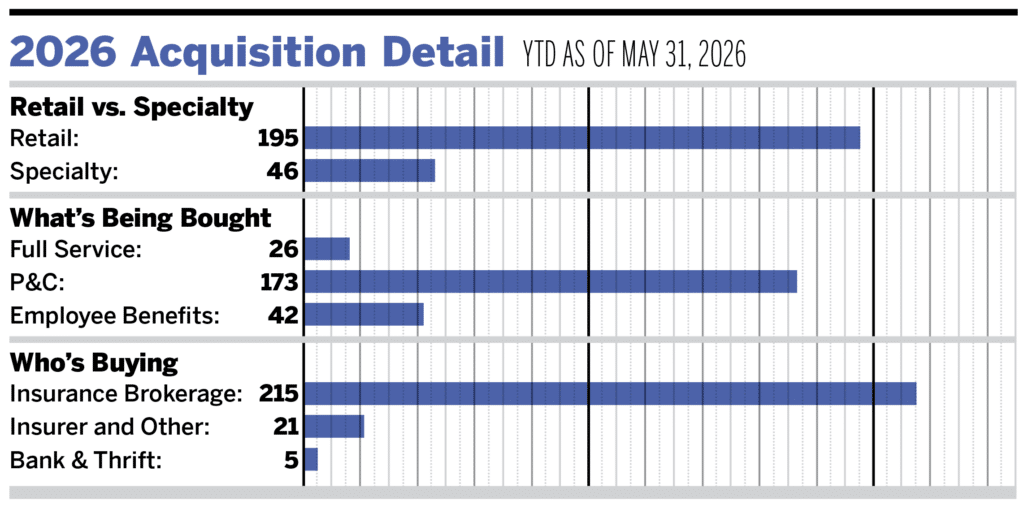
As of May 31, there were 241 announced insurance brokerage M&A transactions in the United States in 2026—down 5.1% from 254 deals last year at this time. Private capital-backed buyers accounted for 170 of the 241 deals (70.5%) through May. Independent agencies were buyers in 23 deals, representing 9.5% of the market. Bank buyers have announced five transactions to date this year. Deals involving specialty intermediaries as targets accounted for 46 transactions, representing 19.1% of all acquisitions so far.
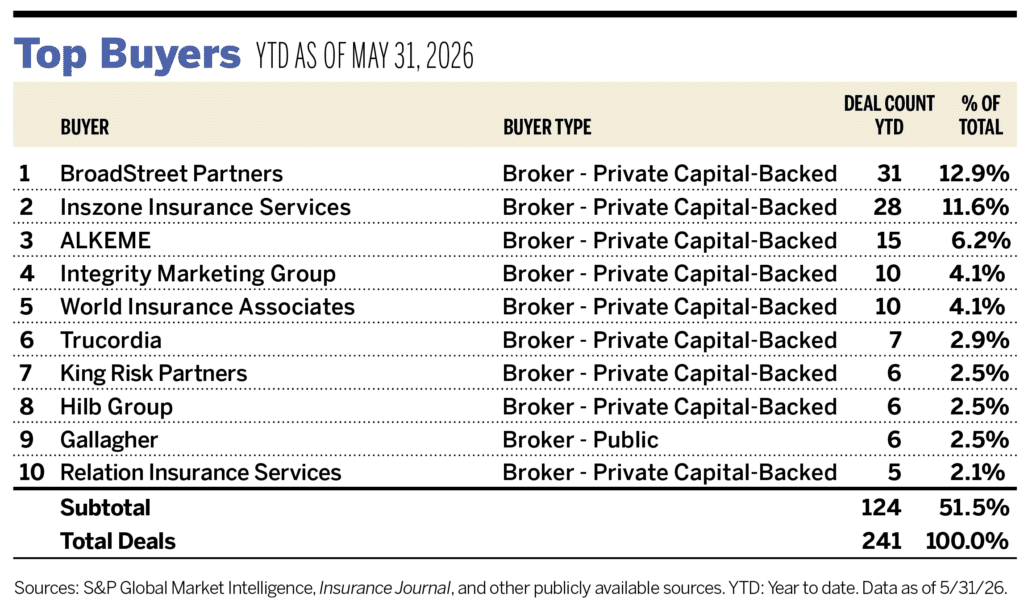
Ten buyers accounted for 51.5% of all announced transactions year to date, while the top three (BroadStreet Partners, Inszone, and ALKEME) represented 30.7% of the 241 transactions.
Notable Transactions
- May 1: BroadStreet Partners acquired Bearing Insurance Group, a Virginia-based independent insurance brokerage with roots dating to 1999. Bearing provides a broad range of commercial and personal insurance solutions, including property and casualty, employee benefits, workers compensation, and business auto coverage. The transaction further expands BroadStreet’s footprint in the Southeast and Mid-Atlantic insurance markets.
- May 1: Hub International acquired Johannesen Farrar Insurance Agency (JFI), a Delavan, Wis.-based multiline insurance agency that provides a range of commercial and personal insurance solutions. The transaction gives JFI access to Hub’s broader resources, carrier relationships, and national platform, while enhancing its ability to serve commercial clients through expanded capabilities, including employee benefits offerings. The acquisition further strengthens Hub’s presence in Wisconsin and aligns with its strategy of partnering with established community-based agencies.