
In Digital Distribution, Age Matters
The success of digital placement requires designing for generational differences in how brokers and clients search, learn, and work.
How should the specialty insurance industry approach digital distribution of its products across a workforce that spans four generations with different levels of comfort with the necessary tools?
It’s a question worth considering because the push to digitize placement has collided with two competing realities. On one hand, every retail operation is under intense pressure to recruit and develop young talent. On the other hand, the institutional knowledge, client relationships, and judgment of more tenured employees are precisely what make a firm valuable. Digital adoption should not be treated as a generational handoff. Successful firms iterating their operating models to best respond to dynamic market changes will bring the entire workforce along as they transition.
One Channel, Many Models
The retail channel has become incredibly varied. The most effective wholesale and specialty firms no longer engage “the retail broker” as a single archetype. Global brokers, regional firms, publicly traded brokerage entities, private equity (PE)-backed retail platforms, independent agents, and network groups each operate with distinct go-to-market strategies, areas of specialty, and competitive pressures. No two are alike in their operating model and the manner in which they leverage their human capital. Today, we must also add the “new” digital retail agency model that scales technology integration across client acquisition, retention, and placement processes at inception.
Those differences shape how each firm approaches the small and micro-commercial segment and, by extension, how it adopts digital placement. PE-backed retailers tend to pursue efficiency and capacity, freeing former independent agency teams to move further upstream while the parent monetizes recently acquired books. Regional and independent firms often lean into relationship value, protecting a segment many of their people have served for decades and keeping pace with insureds’ evolving needs. The largest global brokers have built separate U.S. platforms with industry-specific segmentation, designed to capture and retain small commercial clients in a low-touch, high-value environment.
Each of those models implies a different digital posture. And inside each firm sits another layer of variation: individual users, with their own preferences, skills, and comfort with technology.
Age, experience, and the user’s operating model are not obstacles to digital distribution. They are inputs into it. The firms that design for the full range of digital fluency across both user context and differing retail channel considerations, and account for those differences at both the local and corporate levels, will turn digital tools into genuine distribution advantages.
Considering Age
Generational differences must be considered, not as stereotypes, but as necessary information on how people prefer to find information, to learn, and to work.
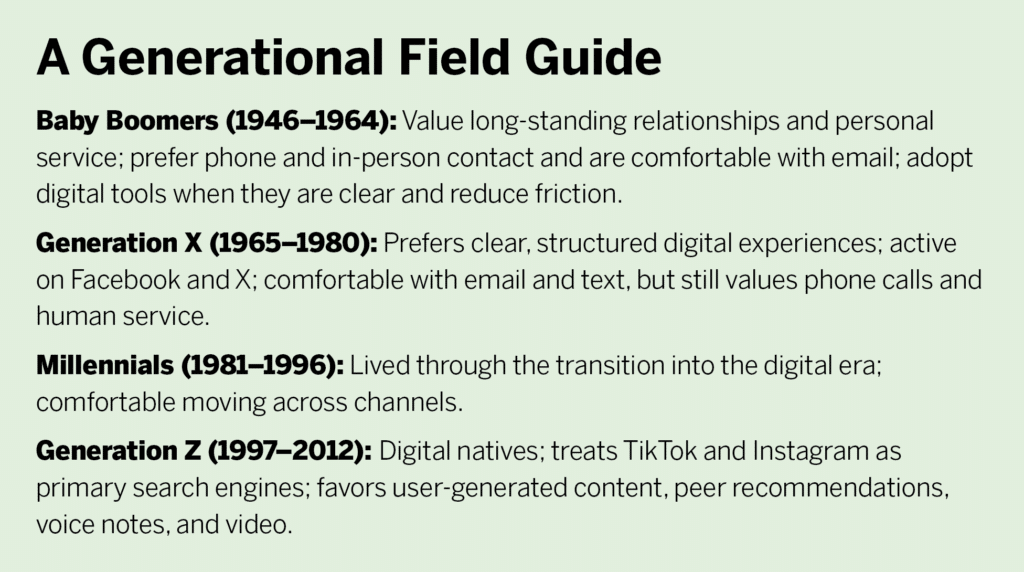
The differences show up well before anyone logs into a platform. The members of Generation Z, the industry’s first true digital natives, navigate the internet through social platforms like TikTok and Instagram, favoring user-generated content and peer recommendations over traditional search. Millennials came of age during the transition into the digital era and move fluidly between channels. Gen Xers often prefer clearer, more structured digital experiences and still value human customer service and a phone call when something matters. Baby boomers, many of whom anchor senior leadership and hold the deepest client relationships, prize personal connections, trusted advice, and direct human contact; they adopt digital tools when those tools are clear and remove friction rather than add it. None of these preferences are better or worse, but each changes how a person responds to a new tool, training session, or marketing message.
Effective digital enablement must be multichannel and multitechnique—offering information that meets users where they are, from TikTok and YouTube to email blasts and webinars.
Human and Machine, Not Human Vs. Machine
It is tempting to frame digitization as cracking a code: get the technology right and adoption follows. In practice, the platforms that earn daily use pair machine learning with human learning to ensure users get the data they need while preserving the personal expertise and service that all clients and challenging risks demand.
RT Specialty’s RT Connector digital platform was built around that balance. A retail agent completes a single application and receives multiple bindable quotes from multiple carriers, then can bind, issue, and service the policy online in minutes—spanning 29 carriers, eight lines of business, and more than 550 classes across all 50 states. When a risk falls outside the platform’s appetite, it is routed automatically to an RT Specialty broker or underwriter rather than turned away. The automation absorbs volume and speed; people supply judgment and handle the complex risks that don’t fit a template. That combination enables a single platform to serve both a 28-year-old producer who wants to self-serve and a tenured account manager who still wants a human on the other end of a hard placement.
Age, experience, and the user’s operating model are not obstacles to digital distribution. They are inputs into it. The firms that design for the full range of digital fluency across both user context and differing retail channel considerations, and account for those differences at both the local and corporate levels, will turn digital tools into genuine distribution advantages.
So, does age matter? In digital distribution, it does. The task isn’t to design around it—it’s to design for it.