Funding Growth
The most successful brokerages don’t just evolve their growth strategy, they continually rethink the capital structure that powers it.
Growth is a common objective across insurance brokerages, but the path to achieving it can look very different from one organization to the next.
Just as every firm’s goals are unique, so are the financial options to support those ambitions. While many businesses invest significant time developing three-, five-, and 10-year strategic plans, fewer spend enough time evaluating whether their capital structure can support those strategies.
A growth strategy often includes plans for organic growth, acquisitions, talent, technology, or leadership perpetuation. Each objective requires capital. But the firm’s existing business model, profit margins, cash flow, or ownership structure may not provide sufficient resources to fund those initiatives at the pace necessary to achieve the desired results.
As brokerages evolve, capital structures that once served them well can become constraints. Ownership arrangements, debt agreements, or perpetuation models that fit one stage of growth may eventually act more like an anchor than an engine. For that reason, capital structure need not be viewed as permanent, but rather as a strategic tool that evolves alongside the business.
Independent firms should not view seeking outside capital as “selling out.” Instead, they should consider it one of many tools available to support growth. In fact, some of the industry’s highest-performing brokerages use external investment and debt financing.
Independent firms should not view seeking outside capital as “selling out.” Instead, they should consider it one of many tools available to support growth. In fact, some of the industry’s highest-performing brokerages use external investment and debt financing. The added accountability that comes with outside stakeholders often drives stronger financial discipline and operational rigor.
Many capital structure options are available, each serving a different purpose. Traditional and senior debt can provide cost-effective growth capital. Mezzanine debt offers additional flexibility for firms seeking leverage beyond senior lending limits. Minority or majority equity investments can deliver both capital and strategic expertise. For larger organizations, a public offering may create access to substantial long-term funding.
Not every capital structure follows a predetermined path, nor is success dictated by business size. Some of the larger privately owned brokers view a public offering as the next step in their evolution, while others are moving in the opposite direction.
The Baldwin Group recently announced its intention to go private. CEO Trevor Baldwin stated: “Our vision and strategy are not changing…. What changes is the pace of our investments in talent and technology.” Baldwin’s capital structure seemingly needed to change to better support that growth strategy.
The key lesson is not which structure a firm chooses, but instead its willingness to continually evaluate whether that structure aligns with its growth ambitions. As growth plans evolve, leadership teams should ask a simple but important question: does our capital structure still give us the best opportunity to achieve our goals?
M&A Market Update
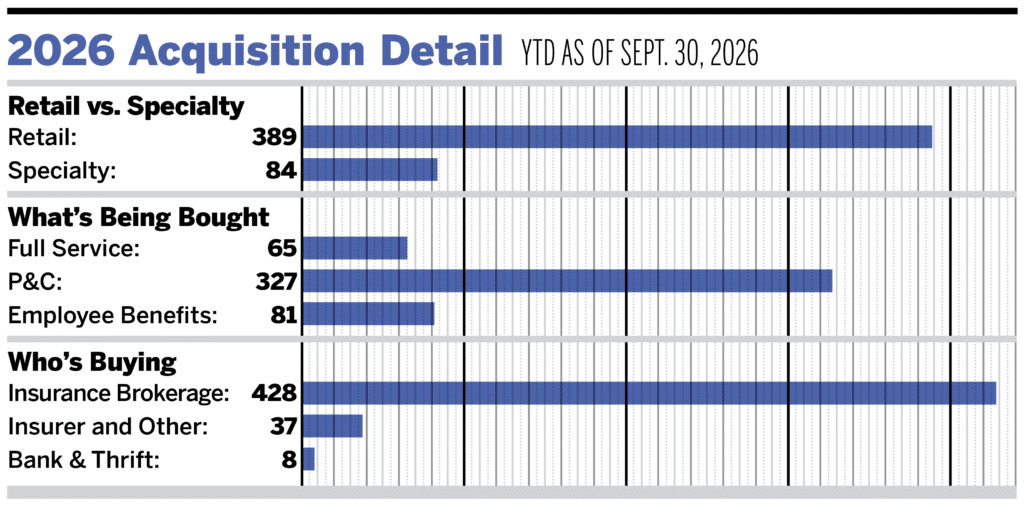
As of Sept. 30, there were 473 announced insurance brokerage M&A transactions in the United States in 2026—down 7.8% from 513 deals last year at this time. Private capital-backed buyers accounted for 358 of the 473 deals (75.7%) through September.
Independent brokers’ share of deal activity has steadily declined over the years, mostly due to private equity’s scaled and sustained increase in M&A. Through September, independent acquirers accounted for 37 transactions, representing 7.8% of the market, while bank buyers have announced eight transactions to date this year. Deals involving specialty intermediaries as targets accounted for 84 transactions, representing 17.8% of all acquisitions.
Ten buyers accounted for 51.2% of all announced transactions year to date, while the top three (BroadStreet Partners, Inszone, and ALKEME) represented 29.2% of the 473 deals.
Notable Transactions
- Sept. 3: King Risk Partners acquired Conover Beyer Associates Insurance, a New Jersey-based independent agency with roots dating to 1882. The agency provides commercial and personal insurance, employee benefits, bonding, and risk management services, with expertise in coastal exposures and several commercial industries. The transaction strengthens King Risk Partners’ New Jersey presence and adds a long-standing regional agency to its East Coast platform. MarshBerry advised Conover Beyer in this transaction.
- Sept. 14: The Baldwin Group announced a definitive agreement to be taken private by an organization established by Sequence Holdings and DFO Management. The all-cash transaction, valued at about $7.7 billion, is expected to be finalized in the first quarter of 2027, subject to shareholder and regulatory approvals and other standard closing conditions. The company plans increased investment in talent, technology, and AI capabilities. MarshBerry advised The Baldwin Group in this transaction.
- Sept. 17: EPIC Insurance Brokers & Consultants acquired Korotkin Insurance Group, a Michigan brokerage that has operated for more than a century. The deal gives EPIC a notable foothold in Detroit and expands its Michigan footprint. MarshBerry advised Korotkin Insurance Group in this transaction.