
What Is the Right Multiple for Broker Valuations?
Higher-than-usual valuations suggest investors are reconsidering insurance broker characteristics like durable and defensible cash flows.
In my last article, “Insurance Broker Valuations Gone Wild,” I commented that in 25 years of working in insurance M&A, I have never seen such a wide gap in broker valuations as exists today.
That gap has only become more pronounced. At the time of writing, Brown & Brown was trading at approximately 11.2x EBITDA. Recently, publicly traded Baldwin, roughly one-fourth the size of Brown & Brown, agreed to be taken private by the Dell Family Office and Sequence Holdings at approximately 20x EBITDA. Prior to that, publicly traded Aon inked a deal to acquire private equity-backed USI for roughly 17x EBITDA.
In 2025, AssuredPartners sold to Gallagher for about 14.3x EBITDA, while Risk Strategies traded to Brown & Brown that year at approximately 16x EBITDA. In the private market where we operate, companies with $5 million to $10 million of EBITDA have achieved higher valuations than public companies more than 50 times their size. At the same time, other private equity-backed brokers with approximately $100 million of EBITDA have stalled in their sales efforts, receiving few or no bids.
This raises a basic question: what is the appropriate valuation for an insurance broker?
Public Markets Provide the Clearest Benchmark
Public market data provides the best starting point for valuing an insurance brokerage. The information is freely available, the financial statements are subject to significant scrutiny, and the results are typically audited by major accounting firms. Together, these factors make public companies a transparent reference point for how investors value insurance distribution businesses.
We have historically viewed Brown & Brown as a bellwether for insurance broker valuations, but it should not be analyzed in isolation. Gallagher and other publicly traded brokers should also be included in a meaningful analysis. This can also include Hub, USI, and HRH, all of which were publicly traded during portions of the period being analyzed, going back to 2000. Looking at a broader group helps distinguish company-specific factors from broader market trends.
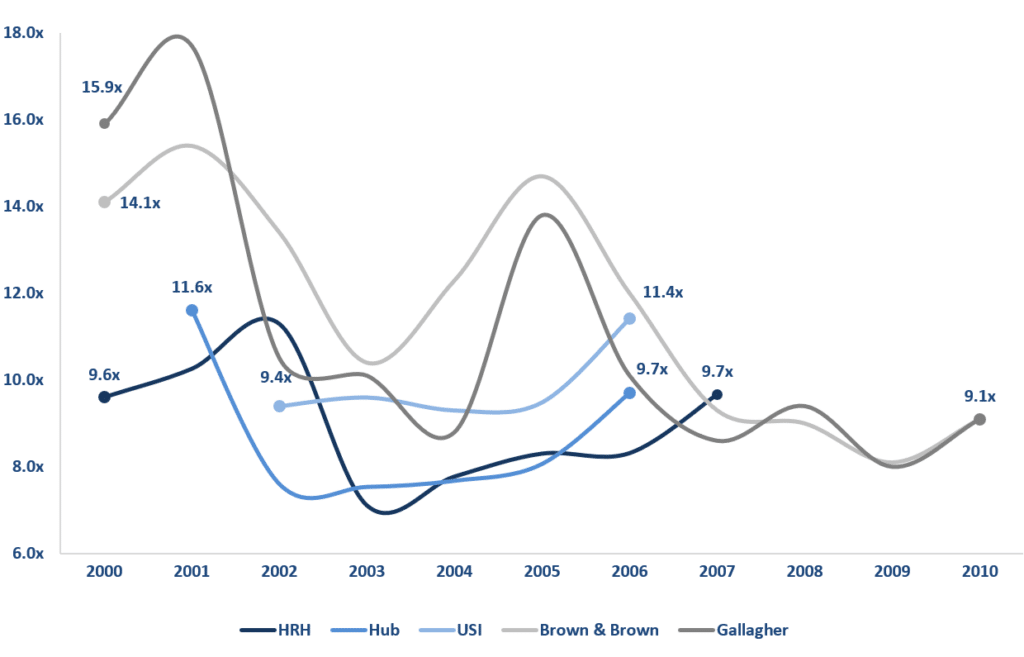
From approximately 2000 through 2010, midmarket publicly traded insurance brokers generally traded at around 10.7x EBITDA. USI and Hub traded at roughly 11.4x and 9.7x trailing EBITDA, respectively, before their takeover premiums when they were bought in 2007. HRH traded at about 9.7x before Willis bought it in 2008.
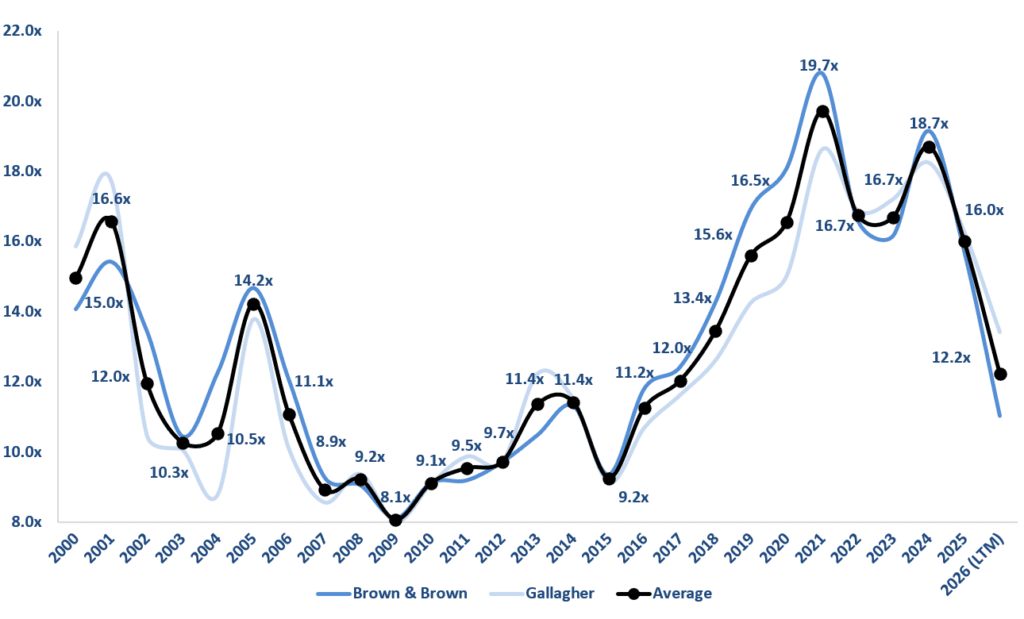
Over the following decade, valuations climbed. Public broker multiples rose from 9.2x in 2016 to about 16.5x by 2020. They peaked at about 19x–20x EBITDA in 2021, driven by heavy private equity demand for the sector.
Beginning in 2022, valuations eased modestly as interest rates rose and investors became more selective. Public broker multiples slipped from their 2021 peak to roughly 16.7x EBITDA and held there through 2023.
If today’s interest rate environment is more comparable to the period before ultra-low rates, then a 10x-12x EBITDA valuation for a large, high-quality insurance broker may appear reasonable. Brown & Brown, trading at approximately 11.2x EBITDA, would seem to fit within that framework.
But how do we explain Baldwin’s 20x EBITDA transaction?
Are Insurance Brokers Similar to Real Estate Investments?
When insurance broker valuations began climbing, I wondered whether the increase was driven solely by lower interest rates or whether something else was happening.
One theory is that institutional investors began to rerate brokers as comparable to real estate assets, particularly high-quality, income-producing real estate.
For example, a high-quality real estate asset trading at a 5% capitalization rate is equivalent, broadly speaking, to paying 20x annual cash flow. Even with the commercial real estate market under pressure over the past two years, it is difficult to find a high-quality real estate investment trading at the equivalent of only 10x-12x EBITDA.
There are meaningful similarities between insurance distribution and real estate as asset classes. An apartment building provides a recurring base of tenants, with a high percentage renewing their leases each year. Recessions may affect occupancy and rental growth, but people need a place to live. Insurance brokers also have recurring-revenue characteristics. Client retention rates are often approximately 90%, and businesses and individuals generally must maintain coverage, whether required by law, a lender, or simply by necessity. Insurance is not a discretionary product for most customers.
In other words, a strong insurance brokerage’s predictable cash flow may resemble the recurring rental income of a high-quality apartment property.That does not mean the two asset classes are identical. Real estate has physical assets, specific financing characteristics, tax benefits, and residual value. Insurance brokers, by contrast, are primarily people- and relationship-driven businesses. Their value depends on client retention, producer productivity, organic growth, margins, carrier relationships, and the durability of recurring revenue.
Still, the comparison raises an important question: are investors increasingly willing to pay real estate valuations for businesses that produce stable, recurring, and relatively defensive cash flow? If so, the market may be recognizing that the best insurance brokers are not simply service businesses valued on current earnings. They are platforms that generate durable, recurring cash flow, more like long-term infrastructure than traditional professional services firms.
That may be one reason the valuation gap has become so wide. The question is no longer simply what multiple an insurance broker deserves. It is which characteristics justify a premium multiple, and whether the market is beginning to value those characteristics differently than it has in the past.