Hail Is Falling, Losses Aren’t
More structures and more vehicles in hail-prone regions are driving up insured losses.
A hailstorm will batter your house, car, or business, but it won’t wipe out your entire neighborhood.
So hail does not inspire the same levels of dread and news coverage as hurricanes or wildfires.
But as annual losses from hail spike into the billions of dollars, sometimes for a single event, the risk has the insurance industry’s attention.
“If you talk about pricing, in the ’90s you would see an average of $1 billion a year in hail losses in the industry,” says Tom Brocksmith, vice president of catastrophe operations for loss adjuster Crawford. “Now we’re around $15 billion.”
Hail has emerged as a clear risk for significant commercial and personal property damage. Up to 80% of the tens of billions of dollars of damage caused annually by severe convective storms in the United States can be linked to hail.
Increasing loss amounts have been tied primarily to large-scale development of new corporate and residential structures in Texas and other at-risk states, along with inflation for repair materials and labor. Climate change is also seen as an increasing factor, intensifying hailstorms and expanding the hazard into new areas.
The insurance industry has taken steps to reduce its exposure, including setting percentage wind-hail deductibles for homeowner policies, using technology to more precisely analyze the risk down to the neighborhood level, and encouraging property owners to use more resilient materials in building or renovating structures.
Insured losses from U.S. severe convective storms (SCS) have landed above $50 billion annually for three consecutive years through 2025 across commercial and personal lines—well above prior years and what previous models had projected. Up to 80% of claims from those storms are related to hail damage, according to the Insurance Information Institute.
While loss amounts will fluctuate, those experiences and more sophisticated catastrophe modeling suggest a new normal. The insurance industry must consider that these costs will not plateau or return to low loss years from a decade ago, says Scott St. George, head of weather and climate research at brokerage WTW.
Even as the January 2025 wildfires in Southern California became the major single natural disaster loss driver for the year in the United States, hail remained the “big story,” adds Jon Schneyer, then-director of research and content at property data provider Cotality. It will be steering insurance and reinsurance companies’ risk and capital management strategies for years to come, says Schneyer, who is now at Guy Carpenter.
Some causes for the increasing losses are well understood: more commercial and residential structures in regions that are in the bullseye for hailstorms, along with cost inflation for repair materials and labor. But industry sources also cite the changing nature of hail events themselves.
“We know that as things warm up, we’re seeing an eastward shift in the frequency of hail and in some places increases in hail intensity,” says Suz Tolwinski-Ward, vice president and head of climate statistics at Verisk Catastrophe and Risk Solutions.
The industry is not sitting idle as losses grow, sources assert. Carriers are updating underwriting, increasing hail-wind deductibles as part of homeowners policies, and encouraging clients to use more resistant materials on their homes to prevent damage and claims. Some of those measures apply to commercial properties as well, but these locations often require additional steps such as protections for HVAC units and other rooftop equipment and business interruption or contingency planning.
“Looking ahead, two emerging commercial exposures deserve increasing attention: data centers, where, as we continue to build more of them, it becomes critical to ensure that rooftop and exterior infrastructure are properly accounted for in risk assessments, and solar farms, whose rapid proliferation across hail-prone regions introduces a growing and still-evolving loss potential that the industry is only beginning to fully quantify,” says Tal Paschal, senior product manager at Cotality.
Hail Claims
Hail claims primarily come from homeowners, followed by auto claims and then commercial insureds, Brocksmith says. Commercial claims most frequently come from operations with large roof footprints, he adds, citing warehouse and distribution facilities, manufacturing plants, shopping centers and other retail, and food processing, among various targets.
For 2025, data specialist Verisk recorded 835,058 homeowner claims for hail damage and 328,606 filings from personal auto policies. It counted 35,812 claims for commercial property damage and 11,064 claims for commercial auto.
Just in the United States last year, the total cost of repairing and replacing residential and commercial structures damaged by hail landed at $22.5 billion, according to separate Verisk data.
“Hail is a really serious [loss] driver. Continues to be driving more and more losses over time,” says Steve Bowen, chief science officer for Gallagher Re. He adds: “Just looking straight at the data, we haven’t necessarily seen an overall increase in the number of events, but the events that are occurring are becoming more costly, they are becoming more impactful.”
In 2023, a hailstorm in Italy generated $6.3 billion in insured losses, Allianz Commercial noted in a 2026 analysis of severe convective storms. Losses in France from hailstorms the previous year exceeded $4.5 billion. In 2024, Canadian insurers reported $2.4 billion in losses following a hailstorm in Calgary. In the United States, State Farm alone reported paying more than $5.6 billion in hail claims in 2025.
Hail Size a Factor
Hailstones form as thunderstorm updrafts push raindrops higher into the atmosphere, where they eventually freeze. They grow by hitting other water drops that then also freeze to the surface of the hailstone. When the updraft loses strength or simply cannot hold up the increasing weight of the hailstones, they fall.
The central United States is geographically and environmentally suited to create supercells—the powerful and extended thunderstorms that generate hail and tornadoes, University of Delaware atmospheric scientist Kelsey Malloy said in a November 2025 discussion organized by WTW. Specifically, “unstable, warm, moist air” coming from the Gulf of Mexico meets wind shear driven by the jet stream coming from the Rocky Mountains.
The largest hail can reach speeds exceeding 100 mph as it comes down, according to the U.S. National Oceanic and Atmospheric Administration (NOAA). Hailstones generally vary in size from a quarter inch in diameter to 4.5 inches—though hailstones up to 6.6 inches were found following a March storm in the Chicago region. Anything above 1 inch is designated severe.
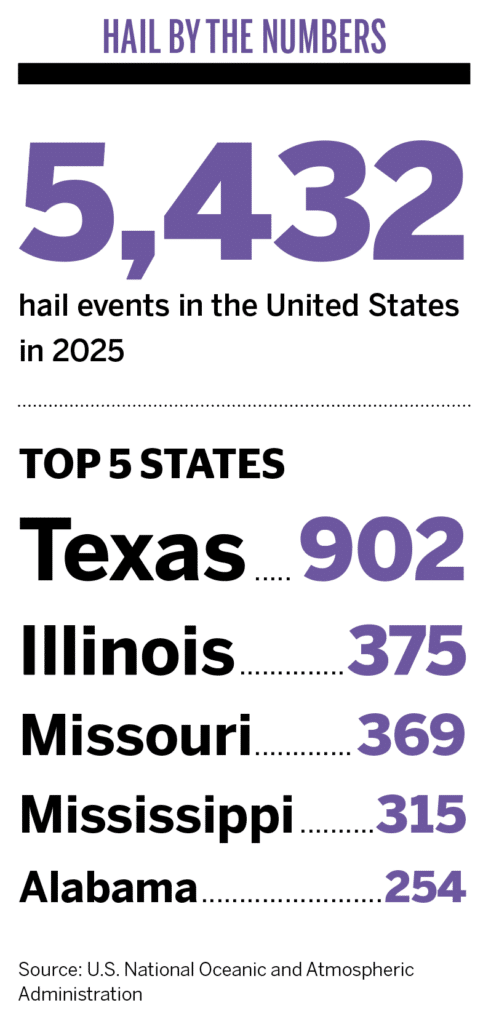
Hail sized 2 inches and higher can inflict significant damage to houses, Cotality said in its 2026 Severe Convective Storm Risk Report. While the number of days with hail that size across the nation varies by year, the trend line has been rising, according to findings since the early 2000s. Cotality recorded 142 days with damaging hail in the United States in 2025, seven days higher than the previous year and well above the two-decade average of 122 days. Over 600,000 homes were struck by hailstones at least 2 inches in size, equal to about $177 billion in reconstruction cost value—the full cost for replacing them all in the event of their total loss. The company did not have a corresponding count for the number of impacted commercial properties.
Cotality projects that more than 43.5 million U.S. residential properties face at least moderate risk of hail damage. Those homes would represent nearly $18 trillion in reconstruction cost value. Only a handful of western states—Nevada, California, Oregon, Washington, Alaska, and Hawaii—appear to face no significant hail threat, the company said in its analysis.
Pricey Homes, Population Spikes
The primary driver of increasing losses and risk is simply more built property in impacted areas, Bowen and others note. As Schneyer puts it, “We’re building a lot more homes, businesses, data centers, solar farms; people are building newer and bigger homes in areas where the cost of living is cheaper.”
Take North Texas as an example. The region surrounding Dallas and Fort Worth added over 300,000 single-family and multi-family housing units from 2021 to 2024, according to the North Central Texas Council of Governments. Fort Worth and Dallas added more than 60,000 new residents in 2024 alone.
Similar population spike stories are being told in Colorado, Illinois, Minnesota, and other exposed states, Bowen says. Cotality calls Illinois a “hidden giant” for potential loss, facing lower risk of extreme events than states such as Colorado and Kansas but with a greater volume of high-priced homes.
Cotality estimates that just shy of 7.9 million homes in Texas are at risk of destruction from hail, representing a reconstruction cost value exceeding $3 billion. That is well over double the number of homes estimated to be at risk in the No. 2 state, Illinois (almost 3.1 million, with a $1.5 billion reconstruction cost value).
“Look at the populations and the growth you didn’t have in Austin before. And now when you have a hailstorm in Austin, it’s more than just right around the university,” says Mary Russell, president of private client services for Texas-based broker Higginbotham. “Look at the outskirts. Look at the damages. Look at the value of the homes that are built there. Look at the roof sizes out there on those lovely big homes. So I think all of that is the frequency of claims, the severity of claims, but then we also have a lot more roof exposure than we had years ago right on top of each other.”
Roofs, for obvious reasons, absorb the brunt of home damage as destructive ice falls from the sky. The cost of replacing and repairing those roofs has increased alongside the number of roofs.
Average residential roof replacement costs grew steadily from 2013 to 2023, from less than $10,000 to more than $15,000, driven by building material and labor cost inflation in recent years; these claims have outpaced the Consumer Price Index and other standard indicators for goods and services, notes Tory Farney, vice president of weather solutions for Verisk.
High-net-worth homes, those valued at $3 million and higher, add expenses by their very nature when hail hits, says Robb Lanham, chief sales officer for Hub International Personal Insurance. The houses are larger and built with more expensive materials, with additional exposures on the property that might not be found elsewhere—high-priced cars, boats, pools, costly landscaping.
“So if you look at a $3 million home, the insurance company isn’t just on the hook for $3 million, you actually double that, it becomes $6 million because you have to cover the contents,” Lanham says.
Commercial Concentration of Value
While hail damage claims from commercial properties may be less frequent than filings for personal property, they can quickly eclipse them on cost, Brocksmith emphasizes.
“What makes commercial exposure particularly noteworthy is the concentration of values,” he says. “A single commercial facility can represent tens or hundreds of millions of dollars in insured assets. Warehouses, manufacturing facilities, logistics hubs, schools, hospitals, and increasingly data centers are all being built in areas with significant hail activity.”
The number of commercial operations exposed to major hail damage is extensive and the losses significant, Allianz Commercial highlighted in its storm report.
The company analyzed more than 3,000 commercial claims for hailstorm losses filed globally from 2016 to 2025, with a total value of 2.2 billion euros ($2.6 billion U.S.). The United States represented nearly half of that total value.
According to the report, the most imperiled commercial sectors include agriculture, with potential destruction of crops and soil erosion; aviation, covering airports and aircraft; the food industry, with both physical damage and the threat of business interruption if plant operations must be halted to avoid breaching hygiene rules; and automotive, where a dealership’s entire lot could essentially be eliminated if an intense storm hits vehicles left unprotected, Paschal says.
“It’s accurate to say that we’re seeing more of a shift regarding asset design in open air environments. Think solar panel farms, rental car centers without garage protection, crop location, etc., which are highly vulnerable to hail impacts and are often located in known risk locations,” Bowen says. “The growing concern is how these types of losses can quickly scale and aggregate to increasingly expensive tallies. As always, the ultimate risk is more often driven by asset location and how it’s built.”
Asset location is an increasingly important point as development of commercial properties has grown in lockstep with rising populations in at-risk regions including Texas, Colorado, Oklahoma, and sections of the Midwest. For example, Dallas-Fort Worth’s commercial sector is growing expansively, with 2.7 million square feet of office space being built as of 2026, PricewaterhouseCoopers and the Urban Land Institute reported.
Data centers and solar installations also made Allianz’s list of most at-risk commercial operations, and both of these types of assets are growing fast.
In a March 2026 report, Swiss Re said its modeling indicates that over one-fourth of U.S. data center capacity sits in locations that receive at least three large hail days annually. A hail day involves no less than a 50% chance of hail, with large hail measuring 2.5 centimeters (about 1 inch) or larger. Data centers are particularly at risk to water damage, due to factors including sizable footprints, low-sloped roofs, and humidity-sensitive technologies, Swiss Re said. Key outdoor equipment also faces direct impacts from hail and debris.
In May 2026, MS Amlin said 320 data centers that are under construction or in planning are located in states at high risk for large hail or other severe convective storm events. The value of operational facilities in high-risk states was assessed at close to $20 billion.
“Data centers stand out because while the structures themselves are often engineered to higher standards, they contain highly sensitive equipment and require uninterrupted operations,” Brocksmith says. “Even relatively localized roof damage can create concerns around water intrusion, cooling systems, business interruption, and contingent exposures.”
Meanwhile, utility-scale solar is growing faster than any other electricity source in the United States, with more than 7,000 solar farms spread across the country, the U.S. Energy Information Administration and other sources say. Texas leads the way here as well, with clear risks when it comes to hail—a 2019 storm damaged 400,000 of 685,000 modules at one Lone Star State plant, with costs of no less than $70 million, PV Tech reported.
Because the hazard is getting worse and should be expected to keep escalating in the future, and exposure has gone up faster than the industry had expected, we will need a faster refresh rate on our catastrophe models, up-to-date measurements of storm activity, and current exposure data—otherwise our estimates for future losses will keep lagging behind the real world.
Scott St. George, head of weather and climate research, WTW
Hail damages represent over half of loss claims for solar installations, averaging $58.4 million for each claim, provider SolarTech says. What’s more, of the 3,013 hailstorm damage claims analyzed by Allianz, solar panels accounted for 6% of the 2.2-billion-euro total value, the third-highest percentage. Allianz also found that renewable power generation ranked fifth among the top industries most impacted by hail.
Solar modules built to withstand hail impacts could be necessary for 100-megawatt plants across much of the United States, kWh Analytics said in its 2026 Solar Risk Assessment. From Central Texas north through Oklahoma, Kansas, and Nebraska, sites also require “robust” stow—positioning panels to limit destruction when a storm hits, according to the report.
“Solar panels will typically be rated to resist the effects of hail, but that rating is only good up to a certain size hail,” says Andrew Higgins, senior regional property technical manager for Allianz Commercial. “Hail that is larger than what the panel is designed for will still cause significant damage.”
Potential Climate Impact
The effect of climate change to date on hail appears limited but experts point to its potential.
Broadly, a warmer environment creates more atmospheric energy for storms that can produce hail, Farney says. More powerful updrafts enabled by a warming climate would generate larger hailstones more often. Different U.S. greenhouse gas emission and climate scenarios could increase the frequency of the largest hailstones by 15% to 75%, researchers reported in Climate and Atmospheric Science.
“The way storms work, hailstorms especially, is the convection of the heat,” Brocksmith notes. “The warmer it is, the stronger that convection is, the larger those hailstorms are allowed to build.”
Climate change is projected to increase the regularity of giant hailstones, according to a May 2026 research paper in the journal Nature. The study found that anthropogenic climate change could boost damage from hailstorms by 36.5% to 42.1% on a worldwide scale near the end of the 21st century, depending on greenhouse gas emissions levels.
WTW conducted research with Columbia University that indicated that the atmospheric conditions necessary for hail-producing severe convective storms occur more frequently now than in the later decades of the 20th century, St. George says. That is particularly true in the southeastern United States.
“We have new tools, we have new data, we have new numbers that give us one perspective on the future of hail risks,” he adds. “But it’s a peril that’s changing fast. And because of that, it’s sometimes difficult to know whether our answers are correct or not correct.”
Research published in 2021 in the journal Nature Reviews Earth & Environment said analysis to that point suggested reduced hailstorm frequency in North America but growing intensity. However, the short time span of this research and other challenges have so far hampered the understanding of future impacts.
Today’s models project a slight decrease in hail activity in the Great Plains as the West heats up and dries, Farney says. The hazard is at least partially shifting east, Tolwinski-Ward adds.
The High Plains ultimately would lose two to four days of near-surface severe hail events, while such days would “increase robustly” outside of the southern Plains, Climate and Atmospheric Science reported. That doesn’t mean the Southeast United States becomes the new Plains, Bowen notes, but a more volatile atmosphere with more heat and moisture could generate more frequent large hail events in states like Florida.
Hail Becoming a Primary Peril?
Over the past decade, the insurance industry has been reconsidering its thinking and approach on limiting exposure to hail losses.
In 2019, Swiss Re listed hail among the “secondary perils” that cause small or midsize losses, along with flooding, storms, and bushfires. Even at the time, the reinsurer noted that secondary perils were “not so secondary”—in fact, in 2018 they caused over 60% of $76 billion in insured losses from natural catastrophes.
“I think hail could now match up with the so-called primary perils, mostly tropical cyclones and earthquakes, in one dimension, total losses from peril,” according to WTW’s St. George. Hail can also be thought of as a “frequency peril,” i.e., something that happens significantly more often than other natural risks, he adds.
Allianz Risk Consulting’s Higgins, though, cautioned against jumping to conclusions: “Before we make hail or SCS a primary peril, we need to allow the data to play out in the coming years. Yes, we have seen a huge increase in SCS/hail losses over the last several years, but we need to know if this has been an anomaly or a permanent trend that needs to be taken into account.”
Models in use over the last decade indicated annual U.S. losses from hail and other severe convective storm damage should be in the range of $20 billion to $25 billion. While those proved correct early on (losses reached $20 billion in 2018, for example, Gallagher Re determined), they proved insufficient as losses exceeded $50 billion annually from 2023 to 2025. Those numbers are comparable with insured losses from some Category 4 or 5 hurricanes that make landfall, Schneyer says.
Looking ahead, two emerging commercial exposures deserve increasing attention: data centers, where, as we continue to build more of them, it becomes critical to ensure that rooftop and exterior infrastructure are properly accounted for in risk assessments, and solar farms, whose rapid proliferation across hail-prone regions introduces a growing and still-evolving loss potential that the industry is only beginning to fully quantify.
Tal Paschal, senior product manager, Cotality
Models in place since last year project that $50 billion in annual losses from hail and other severe convective storm activity should be average going forward, St. George says. The insurance industry now must determine whether those models are correct and whether these record-setting years of losses will become typical for a fast-changing peril.
“Because the hazard is getting worse and should be expected to keep escalating in the future, and exposure has gone up faster than the industry had expected, we will need a faster refresh rate on our catastrophe models, up-to-date measurements of storm activity, and current exposure data—otherwise our estimates for future losses will keep lagging behind the real world,” he says.
Policy Changes
Verisk and other industry organizations in recent years have been updating their modeling use of technology to keep up with the evolution of hail exposures.
Today, insurer modelers incorporate historical hail information, radar imagery, storm tracking, precise property data, and area weather patterns to determine which regions are at risk for more frequent and severe hailstorms, says Loretta Worters, vice president for media relations at the Insurance Information Institute. Insurers can analyze exposure down to ZIP codes or specific neighborhoods, she says. Verisk’s industry exposure database features data on every built structure in the United States, including roof ages. It is constantly updated as part of the company’s catastrophe risk modeling, according to Tolwinski-Ward.
Insurers can compile aerial imagery to give them precise pictures of properties on a house-by-house level. They can determine the ages of houses and roofs, along with reconstruction costs of homes at moderate or severe risk for hail.
Data collected by insurers could contribute to the adjustment of coverage terms, actual cash value settlements for older roofs, or curtailing full replacement cost coverage after roof hits a particular age. The intention is to more closely align coverage with the actual state of the structure and its capacity to withstand damage, Worters explains.
Percentage deductibles for wind and hail, among other policy design updates, have spread across sections of Texas, Colorado, Oklahoma, Nebraska, and other at-risk states over the past decade, Worters says. According to Higginbotham’s Russell, 1% became industry standard in hail-prone regions about a decade ago, followed by 2% in the last three to four years. A couple carriers more recently tried to push that to 3% to 5%, but that didn’t stick, she says.
“The rationale is that when deductibles are more closely aligned with the level of catastrophe exposure, it can help reduce the volume of smaller or marginal claims that contribute to loss inflation and claims volatility,” Worters says. “It also encourages greater consumer focus on mitigation and roof maintenance. While it is difficult to isolate the effect of deductibles alone, insurers generally report that higher deductibles reduce claim frequency, particularly for lower-severity roof claims. Broader claims trends, however, remain heavily influenced by storm frequency, inflation, litigation trends, and reconstruction costs.”
A number of insurers offer parametric coverage for hail damage. Payouts under Swiss Re’s commercial-focused HAIL policy, for instance, are triggered within days of an event by the size of the hail. Damage from hailstones of 2 inches or larger provides a 100% payout, with lower percentages for smaller hail.
Building Resilience
The industry also encourages insureds to protect themselves before hail hits. That includes premium credits or discounts and education programs on impact-resistant roofing and other strengthened building materials, according to Worters.
“Nationwide takes a multifaceted approach to managing hail risk. We advocate for stronger, more resilient building standards and support efforts that encourage durable materials in high-risk regions,” says Jim Gadberry, the carrier’s vice president of personal lines claims. “We also focus on member education, helping customers understand steps they can take to reduce potential damage before storms occur.”
Some carriers offer incentives to insureds that refurbish or build roofs to FORTIFIED standards established by the Insurance Institute for Business & Home Safety (IBHS). The standard requires impact-resistant roof covers, locked-down roof edges, a sealed roof deck, enhanced roof deck attachment, and other measures to increase resilience against hail and other severe weather events.
State insurance commissioners have worked in recent years with the IBHS, industry, and academics to advance messaging around resilience, Bowen says.
“The hope is that we’re going to see this Venn diagram come together where it’s policymakers with decision-makers with consumers actually coming together to understand what is actually going to be most effective to increase that awareness and actually get buy-in,” he says. “I think that we’re certainly past the starting gate at this point. It’s moving in the right direction, but there certainly is a long way to go.”