Who’s Afraid of Virginia Woolf? Not Michael Cunningham
Time is an interconnecting and unpredictable thread among lives in the classic Mrs. Dalloway and its spiritual descendant, The Hours.
Classics of literature are often rediscovered by new generations.
Virginia Woolf’s novel Mrs. Dalloway proved so powerful that it inspired another classic story. Winner of the 1999 Pulitzer Prize for Fiction and the PEN/Faulkner Award, Michael Cunningham’s The Hours is both a tribute to Woolf’s modernist masterpiece and a profound meditation on life, death, and the fragile beauty of ordinary moments. One need not have read Mrs. Dalloway to appreciate Cunningham’s literary achievement.
Cunningham took a tremendous creative risk in writing The Hours. Woolf is not only a key presence in the story, but Mrs. Dalloway is the fulcrum upon which the plot rests. At surface level, Woolf’s novel may appear to be polite British patter about a day in the life of an early 20th century aristocrat. The first sentence is justifiably famous: “Mrs. Dalloway said she would buy the flowers herself.” But Woolf was a master of using a delicate veil to obscure the subdued horror of the human condition beneath. One of her great literary hallmarks was her ability to enter into her characters and intuit their thoughts. Cunningham is adept at this as well.
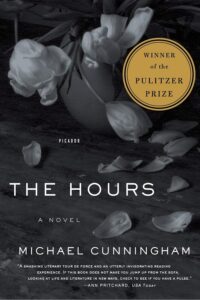
The Hours
By Michael Cunningham
Picador USA
$18
Cunningham had to bring Woolf to life, place her in her surroundings in 1923 Britain, and imbue his entire novel with the rhythms of her language and thought, without allowing her to take over his story and prose style. As a result, The Hours is almost perfect in pitch; the plot and characters are, while Woolfian in substance, clearly of Cunningham’s genesis.
The Hours takes place in three different time periods that converge at tale’s end. First, Woolf struggles to craft a fitting sentence to begin for the story that will become Mrs. Dalloway. Second, emotionally fragile and intelligent housewife and mother Laura Brown is trying to find time to read Mrs. Dalloway in 1949 Los Angeles while carrying a bit too much of the world’s weight on her shoulders. Third, in then-present day New York City, successful editor Clarissa Vaughan is attending to the needs of her closest friend, Richard, a poet ravaged physically and mentally by AIDS.
The fictionalized Woolf is brilliant yet fragile, struggling with her mental illness while working on her novel. Cunningham captures her sharp intellect, moments of creative exhilaration, and the oppressive pull of depression. The storyline is framed by knowledge of her eventual suicide, adding a poignant undercurrent to her scenes while highlighting the tension between artistic genius and personal suffering.
Laura is pregnant with her second child and raising her young son, Richie. Outwardly, she fulfills the role of the devoted wife to her husband, but internally she feels stifled, disconnected, and unfulfilled. Her inner turmoil is revealed in small but telling moments: trying to bake the perfect birthday cake with Richie, a fleeting but intimate connection with a neighbor, and retreating into reading Woolf’s novel. Ultimately, she makes a radical choice, particularly in that era. Laura’s story is an exploration of the cost of self-preservation and quiet rebellion against societal norms.
Clarissa Vaughan is a modern echo of Woolf’s Clarissa Dalloway, a warm, intelligent, and socially graceful woman in her early 50s. Known for her generosity and love of hosting gatherings, she is preparing a party for Richard, a former lover who remains a dear friend. Beneath her composed, vibrant exterior, Clarissa wrestles with undercurrents of regret, nostalgia, and questions about the choices she’s made over time.
Time, constant but elusive, able to confuse and transport, was a central theme in many of Woolf’s novels. Cunningham plays off all of this through successive chapters that carry us both forward and backward in time without any loss of immediacy. As the ailing Richard comments to Clarissa, “I seem to keep thinking things have already happened….I seem to have fallen out of time.”
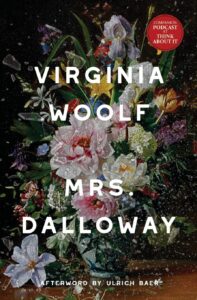
Mrs. Dalloway
By Virginia Woolf
Mariner Books Classics
$10.99
The character of Richard is, I suggest, a modern-day Septimus Smith from Mrs. Dalloway, afflicted in his own way. Septimus Smith in the Woolf novel tragically represents the result of an incurable and consuming despair. This contagion affects his every thought, and unlike Mrs. Dalloway, he cannot resist: “But ‘Lovely!’ he used to cry, and the tears would run down his cheeks….And he would lie listening until suddenly he would cry that he was falling down, down into the flames!”
A Woolf novel unfolds into itself, successively deeper, a labyrinth of ideas leading us to question, often uneasily, comfortable assumptions. Cunningham deftly layers his story on the foundation that Virginia Woolf has laid, updating the characters and surroundings, but in the end still leaving us to puzzle over the same universal, probably insoluble, questions on societal roles versus personal identity, the thin line between sanity and insanity, and the significance of small acts of kindness.