Investigating Mortality
Famed for his explorations of life at the extremes, Sebastian Junger turns his journalistic focus to the question of the afterlife.
Sebastian Junger is known for confronting danger and mortality head-on in his work.
From the deadly seas of The Perfect Storm to the front lines of Afghanistan in War, his books have consistently examined what happens when people are pushed to their limits in harrowing circumstances. With In My Time of Dying, Junger turns that journalistic and investigative gaze inward, using his own sudden brush with death to explore one of humanity’s oldest and most profound mysteries—what happens when we die?
Unlike Junger’s other works, In My Time of Dying is more than a survival memoir. It is a hybrid of the personal and the universal, mixing his narrative with philosophical inquiry, medical processes, and scientific investigation. For me, the book’s true subject, the glue of the narrative, is one person’s confrontation with mortality, and the ways in which we attempt to understand, ritualize, and sometimes transcend the end of life.
A ruptured pancreatic aneurysm, minute and difficult to locate when he is delivered to the Cape Cod Hospital intensive care unit, leaves Junger hovering between life and death. His retelling of this episode is factual and vivid, but never sappy or melodramatic. He describes the sensations, the pain, the disorientation, and the strange lucidity that sometimes accompanies trauma, all with the precision of a war correspondent who understands that the facts are dramatic enough without embellishment.
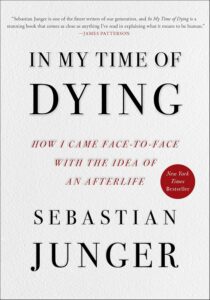
In My Time of Dying: How I Came Face-to-Face With the Idea of an Afterlife
By Sebastian Junger
Simon & Schuster
$27.99
“I was feeling myself getting pulled more and more sternly into the darkness. And just when it seemed unavoidable, I became aware of something else: My father. He’s been dead eight years, but there he was, not so much floating as simply existing above me and slightly to the left,” Junger writes. “My father exuded reassurance and seemed to be inviting me to go with him. ‘It’s okay, there’s nothing to be scared of,’ he seemed to be saying.”
The irony in this moment of dying is that Junger is an atheist, as was his father, a physicist “who didn’t believe in anything he couldn’t measure and test. (Which, as he’d point out, isn’t actually belief.)” Junger, to put it mildly, “was enormously confused” by his late father’s appearance. His rationalism motivates his search for clarity and a pragmatic explanation throughout In My Time of Dying.
Junger is acutely aware that a near-death experience strips away the comforting illusions of control that most of us rely on every day. In the liminal space between consciousness and oblivion, he confronts questions that have puzzled philosophers, religious leaders, and scientists for time eternal. What is the nature of consciousness? Does it survive the death of the body and brain? And, if so, in what form?
Junger’s journalistic skills are on full display. Rather than simply recounting his own experience, he uses it as a springboard for a broader investigation into near-death experiences and the human fascination with the afterlife. He interviews neuroscientists, quantum physicists, anthropologists, and spiritual leaders, probing the boundaries between empirical evidence and subjective experience for the existence of an afterlife and how we might experience it.
Junger is careful to avoid confirmation bias. While he acknowledges the testimonies of those who claim to have glimpsed an afterlife, visions of light and encounters with deceased loved ones, he also examines the neurological effects of oxygen deprivation and the brain’s tendency to impose narrative order on chaos.
One of the most intriguing threads in the book is Junger’s engagement with quantum theory and its potential implications for consciousness. Here, he is attempting to show that much remains to be discovered through science and that quantum physics appears to be the field with the most promise for unlocking the mysteries of a prospective afterlife. “Science stands ready to be disproven by facts,” Junger notes, “whereas religion does not.” He is careful not to indulge in pseudoscience but entertains the possibility that our understanding of reality is incomplete. The idea that consciousness might not be entirely reducible to brain activity, while still a controversial notion, remains fertile ground for speculation.
The result of all this is a delicate and respectful exploration that resists easy conclusions. Junger, seems less interested in proving or disproving life after death than in understanding why humans across time and cultures have been drawn to the idea. He notes that belief in some form of continued existence is nearly universal, and he considers whether this is an evolutionary adaptation, a psychological necessity, or the reflection of something real but not yet measurable through science.
One of the book’s strengths is its emotional honesty. Junger does not shy away from admitting his fear, his reluctance to let go of life, and his awareness of unfinished relationships and emotional business. He writes lovingly about his family, particularly his young daughters, and the thought of leaving them behind to a life without a father. The passages are tender without being sentimental or sugary, giving the book an emotional gravitas that pure reportage would not achieve.
This personal dimension allows Junger to explore a paradox of human mortality. As one example, he reflects on how societies have ritualized death, from ancient burial practices to modern memorials, and how these rituals serve both the living and the dead. In doing so, Junger underscores the idea that death is not merely a biological event but a social, cultural, and business one.
In My Time of Dying is beautifully written and thoughtful, intelligently and rationally inquisitive, emphasizing that human consciousness is far too complex to be understood by today’s scientific and philosophical tools. I think Junger’s closing words sum it up most meaningfully: “We’re all on the side of a mountain shocked by how fast it’s gotten dark; the only question is whether we’re with people we love or not.”