
Steady as She Goes
While seeming to falter just a few years ago, the property market for personal lines is getting a boost from state regulatory and legislative changes and E&S lines carriers.
Several years ago, a hard market coupled with heavy insurance losses due to extreme weather raised the threat of whether homeowners would continue to obtain sufficient property coverage in parts of the country.
With some carriers exiting states and homeowners insurance increasingly difficult to secure in certain areas, there was talk that solutions such as state-run residual markets would need to be implemented or expanded where already in place.
Availability challenges have stabilized in recent years with assistance from replenished carrier reserves, leveling off of property inflation and reinsurance costs, and fewer catastrophic events. But affordability remains a question, and long-term climate challenges continue unabated.
Just a few years ago, property and casualty insurers were pulling back from or even exiting major U.S. homeowners markets in the face of climate-related weather disasters, inflation, rising construction costs, and other challenges, forcing many property owners into state-run insurance pools of last resort.
But the market has started to stabilize, due to legislative changes such as tort reform laws, state roof fortification programs, and expansion of the excess and surplus lines market.
Underwriters have increased access to technology that enables especially detailed and precise data gathering, which allows much more accurate pricing of individual properties based on their particular risks.
State insurance regulators, however, are taking steps to provide longer-term solutions, including tort reform that encourages carrier participation in personal lines markets and risk mitigation efforts with incentives for homeowners.
The excess and surplus (E&S) lines markets also have a role, offering flexibility and niche solutions for properties with increased risk.
“Overall, I don’t think there are any particular pockets of the country that the industry can’t handle right now,” says Bill Gatewood, executive vice president for personal insurance at wholesale brokerage Burns & Wilcox. “I’d say the most challenging areas continue to be wildfire in most of the western states, starting in Colorado. But there’s a lot of good technology out there now that ensures that while carriers are open to writing business, they make sure they are not writing too much in too small of a concentrated area and get hit badly.”
An Improved Market
In 2023, P&C insurers had reduced personal lines product in a number of ways. Insurers stopped underwriting new policies in the more loss-challenged parts of the country or simply exited the market. State Farm and Farmers, for example, heavily scaled back or stopped approval of new property insurance applications in high-risk states like California and Florida due to escalating climate risks, inflation, and rising construction costs. As a result, participation in state property insurance plans of last resort rose by 50% by number of policies in California from 2021 to 2023 and more than 80% in Florida over the same period.
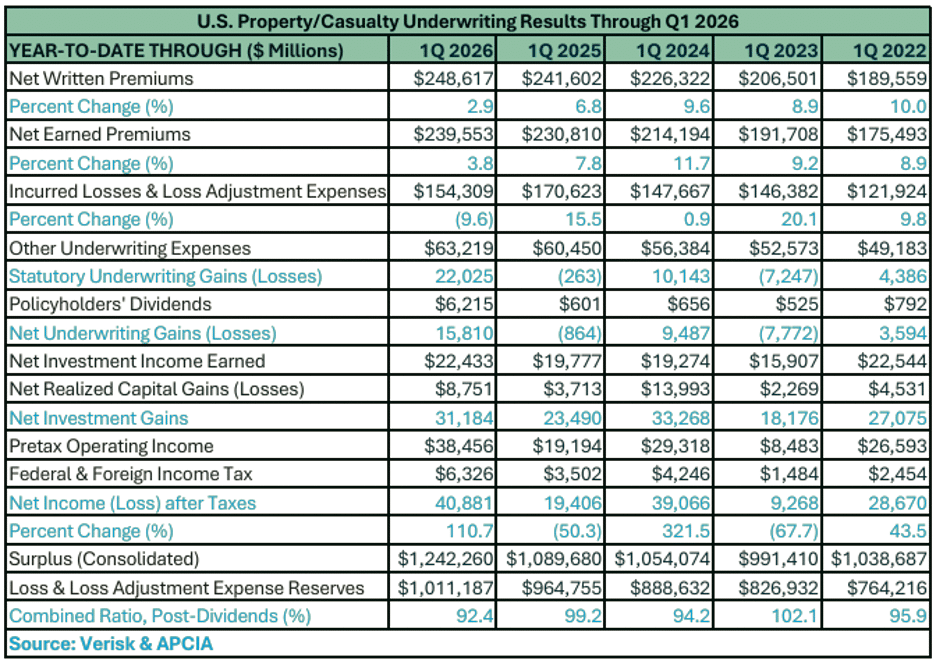
But the P&C insurance market recorded a roughly $15.8 billion net underwriting gain in the first quarter of 2026. Compare that to an $864 million loss in the same period of 2025, which faced significant disasters including the Palisades and Eaton wildfires in California, according to June 2026 data from Verisk and the American Property Casualty Insurance Association (APCIA). The improved natural catastrophe environment wasn’t the sole source of the turnaround, however, as the findings attribute Q1 2026 results largely to ongoing strength in personal auto underwriting.
As the P&C underwriting results chart shows, over the past five years, net written premiums, net earned premiums, net income after taxes, and combined ratio have all improved across the U.S. property and casualty industry.
“I think really at the highest level, our industry is in a healthier position than it was several years ago,” says APCIA Vice President Karen Collins. “The catastrophe risk has not gone away. I think what we’ve seen is we’ve improved the operating environment but not eliminated the exposures. Conditions are materially better than 2023 and 2024. Today, we’re seeing improved insurer results, a more stable reinsurance marketplace, and stronger capital position for companies, and that’s led to a lot more willingness to write in what have been previously very stressed markets.”
For instance, many insurance companies are ready to write business at any location in Oklahoma, says state Insurance Commissioner Glen Mulready. Oklahoma does not need a state plan of last resort for property insurance, he believes. “We have 109 companies licensed to write homeowners business here in Oklahoma. A lot of competition. But we do have an affordability issue.”
A LendingTree study of home insurance rates found that in 2025 Oklahoma had the highest average premium in the country at $5,298, 121% above the national average. Cost drivers include Oklahoma homes’ exposures to extreme weather, such as high winds, tornadoes, wildfires, flooding, and hail, as well as inflation and material and labor costs. These underlying cost factors make addressing affordability challenging, but Mulready encourages consumers to shop for coverage, which pushes carrier competition on prices.
Collins concurs with Mulready on the continuing affordability challenges, which she says extend to both personal and commercial property lines.
E&S Steps In
Excess and surplus lines have long been a significant player in P&C markets, offering coverage that can be priced and tailored for complicated risks that can’t be served in the admitted markets.
When the standard market steps back from covering states like Florida, Louisiana, and Texas following disaster-related losses—particularly if requests for rate increases are rejected— the E&S market can step up to help consumers, says Brady Kelley, CEO and president of the Wholesale & Specialty Insurance Association. Increasingly in recent years, E&S’s reach has extended into personal lines, Kelley says. A beachhead has been high-net-worth individuals and hard-to-insure states.
The percentage of direct written premium (DWP) by E&S lines underwriters grew by double digits from 2017 to 2024, says AM Best Associate Director David Blades. Surplus lines direct written premium as a percentage of total property and casualty DWP grew from 6.9% in 2004, to 7.1% in 2014, and then to 12.3% in 2024, the most recent year for which data is available, Blades notes.
The rate of growth of E&S lines’ share of overall DWP in the surplus and admitted markets has slowed, from 17% in 2023 to 12% in 2024, and Blades says it is likely to dip into upper single digits in 2026. But that doesn’t necessarily mean E&S carriers will pull back as the market softens. E&S insurers today are providing more sustained service and increasing their resources. AM Best’s Domestic Professional Surplus Lines composite showed property line reserve growth of $544 million in 2024, the most positive reserve trend of any line. In addition, a greater number of risk classes present more complex exposures to loss, making them more inherently suitable for surplus lines market solutions, Blades says, citing homeowners insurance in climate-impacted states as a noteworthy example.
The “E&S market has matured its ability to find additional long-term capacity at more competitive costs,” according to Chris Hatt, executive vice president with Amwins Access, and Jason Shrubb, senior vice president with Amwins Bermuda.
Some states are easing declination policies, which dictate how and when insurers can reject a risk, what official notice they must provide, and how the applicant can seek E&S access and alternative high-risk state pools, says Stephen Clarke, senior vice president for government relations at Verisk. In 2025, for example, Florida removed a diligent efforts requirement to access admitted market coverage as a prerequisite to use E&S markets, following the lead of Louisiana, Mississippi, Virginia, and Wisconsin.
Ian Czaja, head of excess and surplus for Verisk’s Core Lines Underwriting Solutions, says that many sophisticated data tools developed for the admitted side are now being adopted by E&S carriers. That includes aerial imagery to identify property risks such as roof damage, overhanging tree limbs, or unreported trampolines. These tools enable the detailed underwriting needed for E&S insurers to cover homeowners properties that are untouchable elsewhere in the market.
“The sophistication has been really accelerating in the non-admitted space, in part because the tools have become much stronger, and in part because the growth of the non-admitted space has started to bring more talent and tool support across both sides of the house,” he says.
Fair Plans Grow And Shrink
Thirty-three states and the District of Columbia have insurers of last resort that provide coverage to consumers who cannot otherwise obtain homeowners coverage in the private market, according to the National Association of Insurance Commissioners (NAIC).
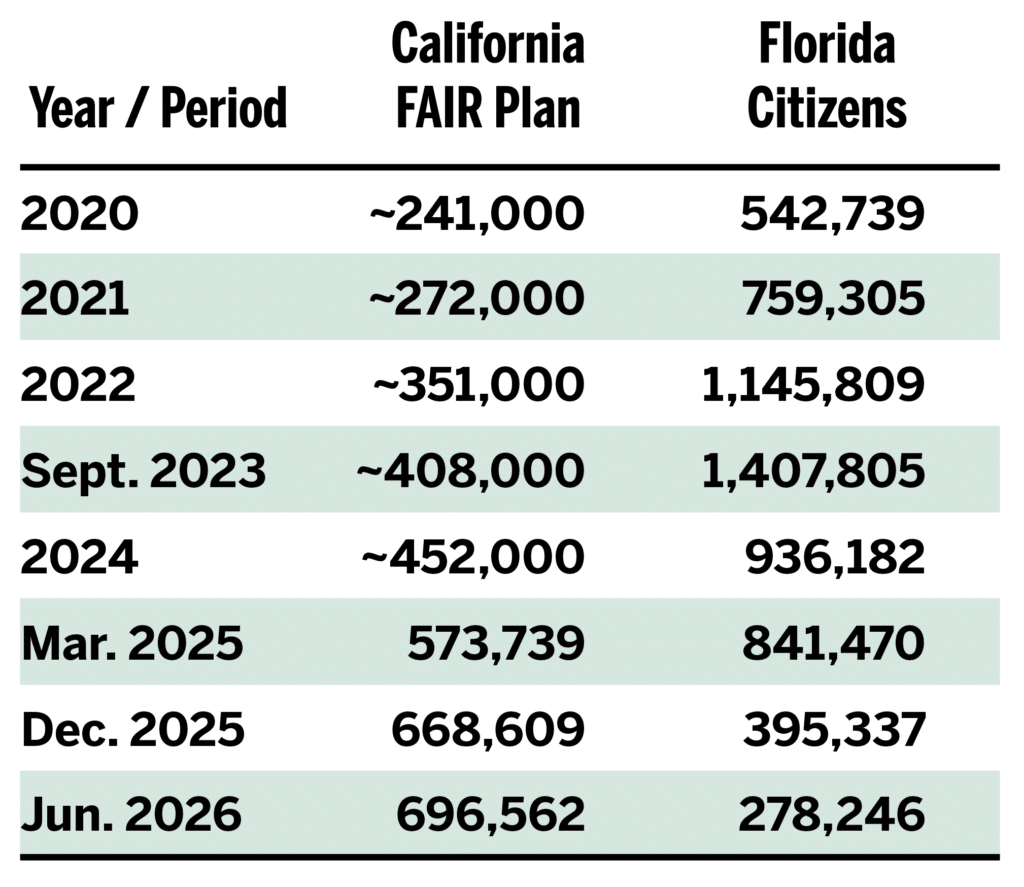
Two particularly notable programs are California’s FAIR Plan, where policies rose by 189% from 2020 to June 2026 (to nearly 700,000), and Florida’s Citizens Property Insurance, where the number of property policies has declined by 80% from its September 2023 peak (to just above 275,000). Those numbers say much about the health of the two states’ P&C markets and state efforts to manage risks in recent years, says John Sence, chief sales officer at MGU SageSure.
“California’s FAIR Plan continues to expand as homeowners struggle to find voluntary-market coverage in wildfire-exposed areas, while Florida’s Citizens has contracted dramatically, as policies migrate back to private carriers following market reforms, increased private-market participation, and successful depopulation efforts,” Sence says.
In 2023, California Insurance Commissioner Ricardo Lara introduced a Sustainable Insurance Strategy, intended to ensure affordable coverage across the state. Among its elements:
- Insurance companies pledging to write at least 85% of their statewide market share in wildfire-distressed areas to increase insurance access in these areas
- Decreasing FAIR Plan policyholders, including through prioritizing homes and businesses that mitigate wildfire risk for transition to the traditional insurance market
- Using new catastrophe models that consider mitigation and hardening requirements to increase the accuracy of risk pricing and the availability of discounts to consumers
The Sustainable Insurance Strategy allows forward-looking catastrophe models in rate making, enhances the state FAIR Plan’s ability to pay claims, and calls for additional changes to help bring capacity back into the market, according to Amwins’ Hatt and Shrubb.
There are some signs of progress, the California Department of Insurance said, such as carriers including Farmers, Mercury, CSAA, and Travelers resuming or expanding policy writing after agreeing to the state’s new terms, along with a slower rate of membership growth in the FAIR Plan.
In April 2025, Colorado became the most recent state to launch a FAIR Plan. “It was because we saw the risk increasing, and we started to hear that availability was becoming an issue again, not broadly everywhere in our market, but in certain specific areas,” says Chief Deputy Commissioner Kate Harris of the Colorado Division of Insurance.
Tort Reform Moves Markets
Florida is the poster child for how state regulatory reform can drive down excessive legal claims, trial verdicts, and settlements that endanger margins and push carriers out of the market, according to multiple sources for this article.
In 2022, the Florida state legislature passed Senate Bill 2-A on property insurance reform, which eliminated one-way attorney fees and fee multipliers for property insurance claims, prohibited the assignment of policy benefits to third-party contractors, and established tighter statutory standards for first-party bad-faith actions against insurers.
In 2023, House Bill 837 on general tort reform shifted Florida from a pure comparative fault state to a modified comparative fault standard. Among its other reforms were barring plaintiffs who are more than 50% at fault from recovering damages, reducing the time limit to file standard negligence lawsuits from four years to two years, expanding the elimination of one-way attorney fees to broader civil litigation, and defining new standards for insurance bad-faith litigation.
Those reforms and other state legislation substantially reduced costs to P&C insurers, thus lessening pressure on premiums and increasing private-market competition, among other meaningful economic gains across the state, according to an analysis from The Perryman Group. The report notes an average 14.5% drop in property and casualty insurance costs in the state relative to the amounts that would have prevailed in the absence of these reforms; a surge of insurers entering or returning to the market, with 17 new carriers approved to write coverage in the state; and lower insurance premiums linked to a reduction in excessive litigation.
In January 2026, Gov. Ron DeSantis (R) announced that premiums would decrease for the vast majority of Citizens Property Insurance policyholders at their next renewal, with an average drop of 8.7% across the state.
“Florida provides us with a really good laboratory of what happens if you enact meaningful reforms in a state that is a high-peril state with a lot of risk concentration,” says Paul Martin, vice president of state and policy affairs at the National Association of Mutual Insurance Companies (NAMIC).
Florida is not alone in its tort reforms, he adds, pointing to Louisiana as another example. Bills signed into law there in 2024 provide the insurance industry with new freedoms to raise rates or cancel policies and reduce legal penalties for denial of claims. Lawmakers repealed Louisiana’s unique three-year rule, which prohibited insurance companies from raising deductibles and either canceling or not renewing homeowner policies in effect for more than that period of time.
“I would say that coming out of 2020, 2021 with hurricanes Laura, Delta, Zeta, and Ida, I think our property market hit…the bottom of a trough,” says Louisiana Insurance Commissioner Tim Temple. “We had 12 companies go insolvent that offered their product here in Louisiana. We had another two dozen or so effectively leave the marketplace. So, when I came in office in January of 2024, with the legislative support and with the governor’s support we tackled property reform.”
Temple says that six new carriers have been licensed in 2026 to do business in Louisiana, matching six new entrants last year. Some companies as of 2025 were decreasing rates in homeowners and other lines, the first such occurrence in five years, he adds.
“I don’t think that rates are going to come back to pre-2020 years,” Temple says. “I think there were a lot of companies that probably were underpricing their product. That’s the reason companies went insolvent; they weren’t collecting enough premium for the risks that they were assuming.”
In many states, the battle over the appropriate level and type of carrier regulation continues. Texas, for one, in 2025 rejected tort reform legislation that was intended to limit nuclear verdicts of $10 million or more in personal injury cases.
In Oklahoma, Mulready says he opposes addressing affordability and availability through more regulation. “I’m a big believer in a free market, a big believer that we need to allow companies to underwrite properly for the risk,” he says. While he acknowledges discussion in the state around being more restrictive on rates, he believes that “there is no better way to chase companies out of our state than to try to put some artificial caps or limits to allowing them to properly underwrite.”
Home Fortification
States have also adopted grant programs and insurance premium discounts to encourage homeowners to use better materials in construction and reconstruction of roofs and other house elements. This helps protect them against severe wind and hail threats, potentially reducing claims for these risks.
The standard for these upgrades is the FORTIFIED home construction system developed by the industry-backed Insurance Institute for Business & Home Safety (IBHS). Among the components of this tiered system are stronger edges to keep roofs from being torn from homes, better roof attachments, and stronger garage doors.
The Strengthen Alabama Homes grant program has disbursed $86 million in grants to pay for installation of 10,000 FORTIFIED roofs over the past decade. Alabama is now home to more than 64,000 IBHS-certified FORTIFIED homes, also encompassing those built outside of the grant program, says Lars Powell, executive director of the University of Alabama Center for Insurance Information and Research. Most are in the two coastal counties, Mobile and Baldwin, where they comprise nearly 20% of all single-family homes.
“Two-thirds of the houses have done this outside of the grant program, meaning a combination of people are learning about it,” Powell says. “They’re buying endorsements that cover it on their insurance policy, but also we believe the roofers are selling it. They’re saying, ‘You know, for just 3% to 5% more, you can have this FORTIFIED roof that reduces your insurance premium.’”
A May 2025 report from the Center for Insurance Information and Research and the Alabama Department of Insurance highlighted the real-world benefits of FORTIFIED construction during Hurricane Sally in September 2020. “Depending on the selected designation, sample, and measure, FORTIFIED construction reduced loss frequency by 55% to 74%, loss severity by 14% to 40%, and loss ratio by 51% to 72%.”
Roughly 30 states are at some stage of establishing programs to support roof strengthening, Mulready says. The National Council of Insurance Legislators (NCOIL), building on Alabama’s experience, offers a model act that states can use to develop a law to establish corresponding efforts.
Since it began issuing grants in October 2023, the Louisiana Fortify Homes Program has paid for 6,000 roof projects, Temple says. A total of 13,000 roofs in the state meet the FORTIFIED standard.
We’re writing flood business in New Orleans, which is like writing fire business on the sun. The only reason we can do that is because we can individually get topography maps of that location. We know the slope of the ground, if it’s up or down, and it allows us to say, ‘There’s six places here, two of them are acceptable for flood, and four of them are not.’
Bill Gatewood, executive vice president for personal insurance, Burns & Wilcox
Oklahoma’s Insurance Department launched the Strengthen Oklahoma Homes Program through pilots in 2024 and 2025 and statewide in January 2026. It has disbursed $4 million in grants of up to $10,000 and has cumulatively funded 400 home upgrades to date.
“I readily admit that I 100% copied the state of Alabama,” Mulready says. “I’m really big on R&D work, rob and duplicate, and so that’s exactly what we did. I wish we could speed that up— we’d like to be doing 1,000 per year, but we’ve been a little bit more deliberate as we rolled that out.”
Mulready says many carriers have independently encouraged their clients to pursue home fortifications of this type, including through 15% to 30% discounts on wind and hail for homeowners policy premiums. The average discount exceeds $700 annually.
Connecticut’s Hershman says the state is interested in a FORTIFIED program but has not found a source of funding and lacks the base of building professionals to install such roofs.
Revising building codes more generally is also part of the home-strengthening solution, says NAMIC’s Martin. Four jurisdictions in Colorado—Boulder and Larimer counties and the cities of Fort Collins and Lafayette—have updated local building codes to require hail-resistant roofing on all new construction and all replacement roofs. “What I hear from the marketplace is that while the Colorado market can be challenging, there’s heightened interest to write more business in those locations simply because they know over time that those roofs will be replaced with more hail-resistant roofs,” Martin says.
Data Drives Better Decisions
Carriers and brokers are now better able to model severe weather damage earlier and more frequently, Gatewood says. Burns & Wilcox can model risk on each individual property it writes, such that typing in an address will produce the hurricane pricing that should be in place for the house and show whether the company has any capacity left in that particular geographic area. He says the ease of accessing data has allowed analysis of risk on a daily instead of monthly basis.
“That allows us to give them broader coverage and maybe better pricing in places that the private insurance market has never been able to write before,” Gatewood says. “We’re writing flood business in New Orleans, which is like writing fire business on the sun. The only reason we can do that is because we can individually get topography maps of that location. We know the slope of the ground, if it’s up or down, and it allows us to say, ‘There’s six places here, two of them are acceptable for flood, and four of them are not.’”
Some states are also delivering more data to residents to make them better home and insurance consumers.
Western Connecticut sustained major flash flooding in August 2024, and many impacted property owners lacked flood insurance. In 2025, Connecticut’s Department of Insurance, in partnership with climate data nonprofit First Street, began offering a free online mapping tool that allows state residents to track their property’s exposure to flooding, wildfires, and other climate change-related risks. The partners hope the tool, which cost the agency upward of $80,000, will help users better understand their insurance needs.
Colorado is targeting similar reforms for wildfires, Harris says. State House Bill 1182, which passed in 2025 and took effect in 2026, requires property insurance companies to make their wildfire and catastrophe risk-scoring models transparent, give homeowners the right to see and appeal their risk scores, and factor property-specific fire mitigation into pricing.
“We want to make sure that a consumer knows that if they have $500 or $1,000 or $10,000 to spend on mitigation, that they know exactly where to put those dollars to have the biggest return, and that the carriers are giving them clear information about how best to mitigate their properties,” Harris says.
Beyond narrow property risk appraisals, there is a need for all involved in homebuying and ownership—buyers, real estate agents, insurance brokers, and insurers—to deal more systemically with the aggregate risk that is being created, according to sources.
Community and consumer decisions on where to locate homes is an enormous risk factor, Collins says: “As you put this in these riskier areas, insurance really simply reflects those costs. Insurance doesn’t create the risk; it just reflects that. These are choices on land use by local governments, states, and obviously consumers where they’re choosing to buy. So this is where we are really strong advocates for smarter land use planning.”
California requires a wildfire risk disclosure as part of real estate transactions. It also mandates a defensible space inspection during the process, a reform APCIA would like adopted more broadly, Collins says.
“I think this was one of the recommendations of the [federal] Wildland Fire Mitigation and Management Commission report from 2024: to provide such disclosures for any sort of federally backed mortgage,” she says. “So when you’re talking about Fannie Mae, Freddie Mac, they should be providing more disclosures as part of real estate transactions. Currently, there are mandatory disclosures if you are in a floodplain, but just because you are not in a floodplain does not mean you don’t have flood risk.”
APCIA noted in January that 8 million homes in Texas alone face elevated exposure to storms, and that 63,000 homes had been built over the past half-decade in areas that flood regularly. The organization called for curbing construction in regions of the state given to extreme weather. Texas state legislation that would have stopped construction in the areas of greatest flood risk and taken other mitigation steps has been repeatedly introduced but not enacted over the past 60 years, according to a May 2026 analysis by ProPublica and the Texas Tribune.
Consumers also must weigh the cost of a house at the time of purchase and the potential expenses over the years or even decades that follow. Overpaying on a house now can lead to underinvestment in insurance and maintenance later, Collins says.
Another determinant of risk is the location of new construction. “One hundred years ago, it was conceivable that you could miss parts of Miami with a hurricane—today, there’s no way it’s going to happen,” says Philip Wray, head of property for insurer MSIG USA. “So, demographics in the way of hurricanes has certainly increased throughout the country, or certainly hurricane-prone zones, so we’re very aware of that.”
The situation with wildfires is similar, he adds, with properties added to the wildland urban interface that probably should not have been built. That exposure must also be managed, Wray says.
Temple agrees that the risk profile has expanded. “I was recently at a company, and they were showing a bunch of their risk, and they showed Google Earth satellite photos of the same areas over time,” Temple says. “If you pick an area like Dallas, Texas, and you go back 10 years, 20 years, 30 years [and you look at satellite photos], it’s nothing but prairie. Hail still fell in those years prior. It’s just now there’s a home with a roof that’s being damaged there. There’s just more exposure out there, and so every state is now trying to figure out what can we do to mitigate against these known perils.”
Temple, though, questions whether many consumers have choices in where they live and work. Two million Louisiana citizens live no more than 50 miles from the Gulf of Mexico and its hurricanes because they work in the region’s oil and gas industry, he notes.
National Initiatives
NAIC members have been comparing notes on their resilience and property insurance regulation efforts and their accomplishments to date. The organization’s Affordability and Availability of Homeowners Insurance Playbook Template, adopted in early August, compares insurance affordability efforts across all states. Specifically, it examines direct consumer impacts, macro trends, and the underlying drivers of affordability and availability pressures; peril-specific state actions and innovative regulatory responses; emerging and widening protection gaps facing homeowners; and strategies, regulatory tools, and implementation considerations to support market stability, consumer protection, and resilience.
Post-disaster efforts stand out as an area where more state regulatory effort is needed, says Mulready, vice chair of NAIC’s Pre-Disaster Mitigation and Risk Modeling Working Group. “Most of our [state] work is at the predisaster stage, but I think it would certainly help if there could be some sort of a state-federal partnership post-disaster,” according to Mulready, who has raised the issue at the NAIC. “[Such as] if the federal government came in after a storm and with the aid they provided, insisted upon, and helped fund, so that when the roof gets replaced, that it’s done to a FORTIFIED level.”
Another issue he has discussed at NAIC with colleagues is encouraging insurers to offer endorsements so that necessary roof replacements are built to FORTIFIED standards. Five states have already done that, Mulready says. A challenge there would be whether IBHS has the resources to ensure states are in compliance with its fortification standards if the program scales up rapidly, he adds.
Several states have also enacted legislation that supports establishment of tax-advantaged catastrophe accounts, including Alabama, Mississippi, and South Carolina. The accounts are intended to assist policyholders in paying for expenses incurred or related to a major natural disaster, such as deductibles for homeowners, flood, or earthquake policies.
NCOIL supports additional state or even federal legislation to expand access to these accounts to allow “pre-event mitigation and post-event recovery by accumulating funds that can be used to supplement their insurance coverage and offset the costs of remediation and repair, and to otherwise protect their personal, family, or household dwelling,” says NCOIL CEO Will Melofchik, echoing the organization’s 2024 resolution on catastrophe savings accounts.