Remote Work’s Risks to Mental Health
Q&A with Terri Bacow, Clinical Psychologist in Cognitive Behavioral Therapy, and Betsy Schwartz, Senior Director, Center for Workplace Mental Health
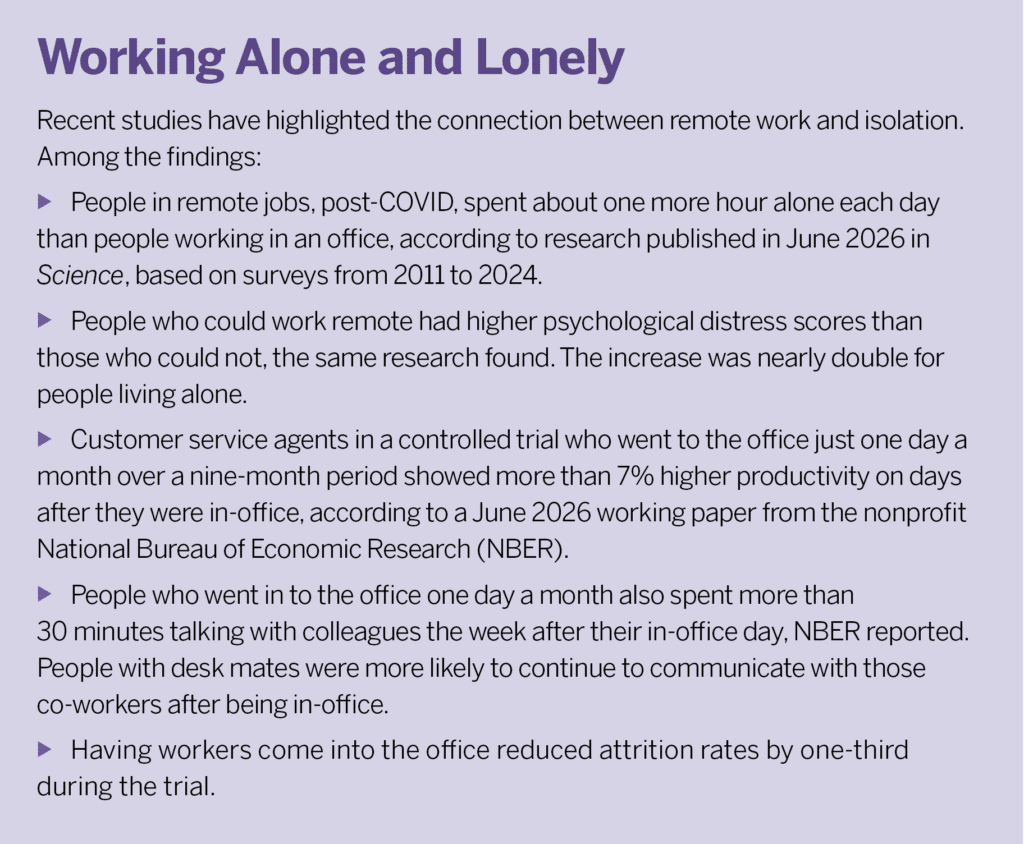
A study in Science, published in June, adds to a growing amount of data showing a correlation between working at home and depression.
The study compared people in jobs that are amenable to remote work (like marketing) and ones that aren’t (like nursing). It found that, post-COVID, those in remote jobs spent more time alone during the day, less time out of the house after work socializing with others, and reported more mental distress— especially if they lived alone. Bacow and Schwartz react to the findings and discuss the potential mental health pitfalls of working from home.
Q
We are connected through technology more than ever, but research shows that’s not enough to maintain good mental health. Why is that?
A
TERRI BACOW: We require social input, and we gain energy—even if you’re introverted—from social interaction. You can’t avoid those social interactions when you are at work. There are going to be meetings, and even when you leave for lunch and then come back, there are people around you. That makes a difference even if you aren’t interacting with them. You get a sense of belonging and a sense of being part of a community.
BETSY SCHWARTZ: The Center for Workplace Mental Health recommends employers start meetings that are remote with some kind of social interaction, like talking about a pet that gets into the Zoom call. Or you can have everyone start by talking about something not related to work—a member of their family, or what they did over the weekend, or what they’re going to do over the weekend. It really is encouraging and creating space for that kind of social connection, even if it’s over Zoom.
Q
This Science study found that people who work remotely don’t get out as much in the evenings as those who work on-site. Why is that the case?
A
BACOW: When you go out, it’s a transition. You have to put effort into it. You are already out because of work, but if you are home, it’s a heavier lift to do the steps to go out. I think it’s just less of a transition when you have the momentum going. It’s really tough to put effort into making that transition, but the payoff is tremendous.
If people have preexisting anxiety or depression, remote work would likely worsen that. But even for people who do not have preexistent anxiety or depression, it wouldn’t surprise me if they would have some of those symptoms, too.
Terri Bacow, clinical psychologist in cognitive behavioral therapy
Q
Do loneliness and depression hit across the board for remote workers? Or are they more likely for someone who is already susceptible?
A
BACOW: If people have preexisting anxiety or depression, remote work would likely worsen that. But even for people who do not have preexistent anxiety or depression, it wouldn’t surprise me if they would have some of those symptoms, too.
Q
Many people who work remotely probably have a full social life and still face mental health issues. Is there more to it than just not seeing people all day in person?
A
BACOW: There are ingredients that we factor into mood management that people aren’t always aware of, and one of the biggest things is structure. People need to have a schedule and when they are working from home it’s harder to have that structure and routine.
For instance, people who are unemployed get more actively depressed, not just because they’re worried about their job loss. When they are working, they know how to structure their time. Structure creates limits and reduces monotony. One of the things that’s hard, I think, about working remotely is it can be like [the film] Groundhog Day. Day in and day out it’s rinse and repeat, and there’s no variety. But what structure does when you go into work is, it breaks that up. Now I’m having lunch, and I have a meeting later, and at 6 p.m. I’m signing out and leaving work. This is why being busy and having a good routine helps people. When we treat depression, we take accountability for creating structure.
Q
What symptoms should employees look for that might signal they are becoming depressed?
A
BACOW: If you are feeling less happy, or more sad or irritable, I think those would be major indicators you may have to monitor your mood. Hypersomnia—sleeping too much—or insomnia—sleeping badly—would also be examples. If you aren’t feeling hopeful about the future, if you’ve started feeling more hopeless or you aren’t excited about the things you normally like, the technical term for that is anhedonia.
SCHWARTZ: Our training, which is called Notice.Talk.Act. at Work. is an opportunity for employees, whether they’re managers or peers, to understand how to notice, whether it’s online or in person, if someone’s struggling.
For example, somebody who’s usually very punctual on meeting deadlines is not. Or if somebody isn’t able to concentrate, that can be a sign. Or if someone is usually the life of the meeting and all of a sudden, they are very withdrawn. You have to really pay attention. You have to be mindful of noticing changes, and then when you do, you have to have the confidence and comfort to have a conversation with them.
Q
What should people do if they work remotely and are dealing with depression?
A
BACOW: If it’s an option, I would take the opportunity to go hybrid, even if it’s one day a week. If it’s not an option, you’re going to have to do some things on your own.
Start by getting dressed every morning. Do not “go to work” in your pajamas. Take a shower, do all the things you would if you were going out of your house. Have a clear start and end time. If you can leave the house for any reason— just to buy toilet paper, or meet someone for lunch, or take a walk around the block—do it. Activation is usually doing something fun that contributes to a sense of positive reinforcement. But if that’s not possible, even doing something productive that is unrelated to work can give you a sense of accomplishment. Like doing the laundry—you’re doing something productive and you have a sense of control of your time.
The first choice would be in-person contact. But if you can’t meet someone for lunch or dinner, then you reach out to people and call or send a text. It means you have to be motivated and make the first move, but it’s worth it. And maybe you set a goal that you’re going to reach out to one person a day.
If you’re in a Zoom meeting and you notice somebody’s struggling, you don’t want to call that out in the middle of the meeting. You want to have a private space, even if it’s a Zoom space, to talk with them.
Betsy Schwartz, senior director, Center for Workplace Mental Health
Q
How can employers best broach the subject if they think a team member might be struggling?
A
SCHWARTZ: We teach people how to talk to somebody if you’re concerned, and then when you’re talking to them, how to help them get the right kind of help. Instead of asking if something is wrong, it’s best to create space by saying that you notice they aren’t taking breaks, or not paying as close attention to deadlines, or some other kind of change in their behavior. Then ask if they would like to talk about it or if there is anything you can do to help. Try not to be intrusive, respect their boundaries, but at the same time validate that you’re concerned.
Everybody wants to be helpful, but how isn’t always common sense. For example, one thing people often do is, if somebody says they are really struggling because their mother just had a stroke, or somebody just died, it’s common for the person who’s wanting to be helpful to start talking about their experience when they had a similar situation. They may say, “I know exactly how you feel because I had that happen, too.” But that’s really not helpful, because it’s taking attention away from the person’s experience and putting it on their own. Also, nobody really knows exactly how someone else is feeling, so they shouldn’t imply they know exactly what they’re going through.
If you’re in a Zoom meeting and you notice somebody’s struggling, you don’t want to call that out in the middle of the meeting. You want to have a private space, even if it’s a Zoom space, to talk with them.
Q
You mentioned that motivation drops when a person is depressed. How does someone who has no energy become motivated to do things to feel better?
A
BACOW: The treatment for anhedonia is to do the fun thing, even if you don’t want to do it. But I understand it can be challenging because you’re not motivated. So, this is where having someone to do it with you is really, really important. You can say to your spouse, child, or mother, “I’m having a hard time, and I need you to get me out of the house,” or “I need you to cook dinner with me,” or “Please do this workout with me.” Engaging family members is [motivating] because they can provide accountability. During depression treatment, the therapist will often have someone commit to doing some activity every day in a week and then the patient is accountable to the therapist. I think therapy, seeking treatment, even if it’s virtual, is a really good idea.
Also, not every job has co-workers, but if someone does, they can start a book club or an affinity group. Get people to join you and play pickleball one day a week. Or get together on a group chat and make a recipe together. During COVID, my husband was working so much, but they had a painting project, and they were all painting pictures of cows as a bonding group exercise. We still have the picture.