Navigating Cancer Care
Q&A with Dr. Christine Hale, Chief Medical Officer, U.S. Benefits, Gallagher, and Dr. David Debono, Oncology Medical Director, Carelon Health
Cancer care navigation helps patients and caregivers coordinate appointments, understand the diagnosis, and manage symptoms, among other efforts, to improve patient outcomes.
Hale and Debono discuss how cancer care navigation services can improve the quality of treatment for patients while reducing costs for both patients and employers.
Q
How does cancer navigation work? How do you connect with new patients?
A
DAVID DEBONO: The navigation system is activated when there is an initial treatment authorization. When that comes through, we have a predictive analytic platform that risk-stratifies members, and our navigation team sets up a queue so the highest-risk members get reached out to first. The navigation team calls them at home; I believe at least six calls are made. When we get somebody on the phone, we explain the program to them, and we get about an 85% to 90% engagement rate, which is very high for these kinds of programs.
These patients fill out an initial application with a navigator to get a better understanding of their social determinants of health, their understanding about their diagnosis, and their needs. If there is a considerable lack of comprehension of the drugs they’ve been asked to take or of the prognosis or diagnosis, those are the nuggets of information that would be fed back to the practice so they can reach out to the member. And if navigators develop an urgent concern, like the member is developing an unexplained fever, it’s typically addressed immediately with a three-way call with the patient and the practice and a warm handoff.
Q
What is the importance of a health navigator for someone newly diagnosed with cancer? What can navigators do that the healthcare system doesn’t?
A
DEBONO: What we have found is that no matter how robust a cancer practice or a cancer center is, there are significant gaps in the patient experience. The patient and family are being bombarded by a lot of new experiences, new language, securing appointments and securing transportation, and trying to figure out what their health benefits offer regarding some of these supportive measures. It’s the navigation team that is connecting with the member and family. The team is trained to report back to the oncology practice if they identify concerns. Maybe Mrs. Jones didn’t make it to her appointment this week. The navigation team may find out it’s because of transportation issues that the practice was unaware of, or maybe there’s some safety issues and concerns at home, or there’s support issues at home. These are the pieces of information that may or may not be uncovered by the practice but oftentimes get lost in the shuffle.
Q
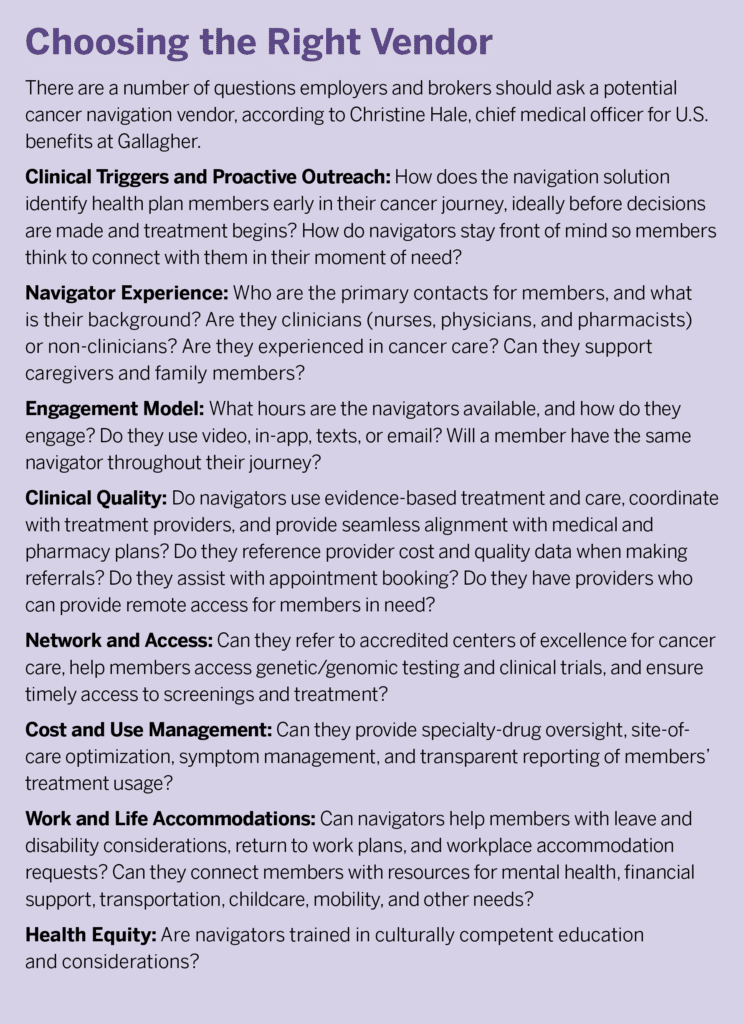
What should employers and brokers know about vetting cancer care navigation vendors? What questions should they ask potential vendors?
A
CHRISTINE HALE: A detailed capabilities assessment must be married with claims data, employer demographics, culture, and objectives to identify the best fit for a partner. Questions that should be asked to any potential vendor (cancer or not) include financial independence and stability of the company, billing model, definition of engagement and engagement rates, ability to integrate/collaborate with the payers and other clinical partners, and how the solution will partner with the employer for things like communications.
Q
Your engagement rate is at least 85% among people who answer their phones. What’s your overall engagement, and do you have other ways of bringing people into the navigation system?
A
DEBONO: It’s a challenge. For any given month, if we’ve identified 1,000 [health plan] members who we believe are high-risk and high-need, we’ll ultimately engage 35% to 40% overall. We do have the ability to take direct referrals into the program from doctors. [We have a] provider enablement team that works with practices to advocate and educate about the navigation program. So, if they feel a member would benefit from navigation, that team knows how to contact and refer patients. There’s a variety of ways to get members engaged.
What we do try to avoid, to be perfectly honest, is reaching out to patients who don’t have cancer. People might ask why we don’t reach out to everyone who had a PET scan that said they have lung cancer. That makes sense empirically, but a lot of times they get a PET scan for suspected lung cancer and they find out it was a chronic lung infection, not cancer. And then they have a cancer navigator contact someone who is already very scared they have cancer? We have to be really right.
Q
How can care navigation save money for employers and patients?
A
HALE: There are many opportunities for cost reduction throughout the cancer journey. Shared decision-making is a major component of ensuring the member’s priorities are included from the start. Cancer treatment can feel like a runaway train, and newly diagnosed people are often scheduled for their first treatments at the time of diagnosis when they are feeling overwhelmed. Time and care should be taken to discuss treatment options, differences in success rates, and possible side effects. Some members may not want to pursue the most aggressive treatment option if it means sacrificing quality of life. Similarly, palliative care should be consulted to help address symptoms and potentially help members through end-of-life decisions related to treatment. A member’s ability to opt out of aggressive therapy at any point gives them control and prevents employers from paying for therapies members don’t want.
Once members are diagnosed, treatment should be optimized. Employers should ensure coverage of tumor biomarkers mirrors recommendations by the National Comprehensive Cancer Network, so coverage evolves alongside the technology. For members on infused medications, looking at alternative infusion locations (up to and including at home for certain stable patients), alternative delivery mechanisms (injection versus IV), and alternative procurement and sourcing strategies can deliver significant savings. These strategies can be more complex in the setting of cancer than for other conditions, so strategies may need to be deployed on a member-by-member basis.
Finally, clinical trials can offer a member early access to new therapies, and the cost of the medication or other intervention being tested is frequently covered by the trial sponsor, removing it from the plan’s responsibility. Vendors that help guide members to appropriate trials and assist with enrollment are emerging to assist plan members.
Cancer navigators can and do assist with these various levers. However, some have strengths in different parts of the spectrum [of care], so data must be used to evaluate fit. Any third-party partner should be transparent about how ROI is calculated and be open to independent verification of their results.
DEBONO: If we can make a connection both to the member and the practice around the issues that are affecting utilization, particularly avoidable utilization, then we think value will follow. Identifying things early and connecting with oncologists when there are urgent concerns makes a difference. So does making sure a patient gets to their appointment and making sure a patient is adherent to the treatment they’ve been prescribed. There are a lot of obstacles for some members getting the drugs they need to take; if they’re not adherent for whatever reason—whether it’s financial, convenience, interactions with some of their other drugs that they’re worried about—a patient will have their cancer inadequately treated, and that will lead to unnecessary utilization. There’s a lot of ways to affect the day-to-day care a member is getting, and it really is important to connect with the oncologist in that regard. Ultimately, if you can manage all of that, you’re going to have value.
Q
Some navigators offer cancer screenings to increase early detection. How many companies offer that service, and can it improve health outcomes and save employers money?
A
HALE: The cost of late-stage cancer at diagnosis can be four times the cost of finding early-stage cancer, making screening and early detection critical. Removing barriers to traditional screenings (lowering screening age, bringing screenings on-site, ensuring recommended screenings are covered on the plan, promoting primary care, and giving time off from work to go to screening appointments) helps members be compliant.
Newer technologies are emerging that are less invasive and more convenient, for example, FIT testing for colon cancer [fecal immunochemical tests, which people can perform at home] and digital skin exams. Priced appropriately, these new technologies provide important options to help members be compliant with recommended screenings.
Multicancer early detection tests are entering the market and may get U.S. Food and Drug Administration approval in the coming year. These tests hold promise for achieving early detection for cancers that don’t currently have tests available and that often present at late stage, such as pancreatic and ovarian cancers. However, individual employers need to independently understand the ROI for their specific organization, as these tests can be fairly expensive.
Not all new technologies that can detect cancer earlier make for good screening tests. It is important to consider the cost of the test itself, the likelihood of detection, the cost of any follow-up testing to confirm a positive screen result, and the cost and risk of interventions pursued on false-positive cases.