Saving Through Your Teeth
Q&A with Matthew Hawley, Executive Vice President of Payment Integrity Operations, Cotiviti
Changes in dental practices in the past decade have led to waste in the system, says Matthew Hawley of Cotiviti, a health infrastructure specialist.
The result is overcharging for services rendered—that could be a dentist splitting billing to increase reimbursements, potentially for unnecessary procedures, or billing for services that aren’t documented. Hawley says payment integrity systems can save employers thousands of dollars per year by catching, flagging, and analyzing claims to avoid overpayment for unnecessary or improperly billed services.
Q
Why has it become increasingly common, or easier, to bill improperly for dental services?
A
With the consolidation that’s happened in the dental space, we’ve moved away from a cottage industry with single-shingle dentists. These larger practices have moved from a singular practicing dentist with a small office staff that handled the billing (often by family members) to a corporate structure. That led to a situation where the company is billing on your behalf, and they have a specific objective: to maximize revenue for shareholders. Maximizing their revenue certainly leads to waste and, likely, some abuse.
Q
How has consolidation changed the way dentists bill for services?
A
Billing is not static; it evolves over time with different procedures that come out. That also lends to the opportunity for errors and for situations where a dental practice can bill to the lowest common denominator [the most relaxed billing guidelines]. They do business with many carriers, and they don’t memorize the patterns and policies of every individual carrier or health plan or dental benefits provider. So, they often just bill everybody in the way that the most lenient payer allows. This least-common-denominator approach to billing also lends itself to waste.
Q
How long has this been happening?
A
It’s been going on for at least a decade. I haven’t studied it closely, but I’ve had dental providers get snatched up by companies. What you generally see in the industry [is that] the medical space has become increasingly penetrated with payment integrity organizations. As that has matured, there is diversification of services on both sides of the arms race for the healthcare dollar. One side is trying to maximize for providers, and payment integrity companies are trying to rightsize [billing] on behalf of payers.
Q
So, moving away from more personalized care may bring consistency to the way patients are treated in larger practices, but can also increase waste?
A
You present with something similar to a bunch of other patients who have come in, and it puts you at the top of this funnel. Then you go down this care path because it’s designed for that broad range, and some of those services you really need, and some of those services you really don’t. But the dental office is aiming for consistency of treatment. From the dental services organization side, that consistency Matthew Hawley makes things easier for the payer or for the member, but it can make things more expensive because you’re rendering some services that might technically not be necessary.
Here’s a specific example: a dentist prescribes a crown for restoration of some periodontal disease and tooth decay. It’s not uncommon to get a recommendation to get a crown. But the patient might say, “I don’t feel like I need it because I’m not having any pain or anything like that.” So, they got a second opinion, and the next dentist didn’t see any presence of decay, no disease, and didn’t believe a restoration or a crown was necessary. In fact, I had that happen to me personally. It was exactly this scenario. I went to my dentist, which is now owned by a large company, and they recommended a crown. I got a second opinion from a dentist who was an individual practitioner, and he said almost the same things as the other claimant. He didn’t think I really needed a crown and gave me a bunch of reasons why. So, that common treatment plan leads to these kinds of situations where services are rendered because you fit in the top of this funnel. You have some elements of the diagnosis, and recommendations are made that are not necessary for treatment.
Q
How much money is spent on excessive billing in the dental system?
A
Each company treats benefits differently, both in medical and dental. In the dental space, how much a company pays is quite variable depending on where they are and what their approach to benefits is. In general, though, a good number to use for the dental premium dollars is about $1,000 per employee per year, split between the employer and employee. That means in the commercial space across the board in the United States, there is about $190 billion of dental spend annually, so it’s not an insubstantial number. The portion of waste that’s in the dental space is about the same as in the medical space—it’s about 10% of spend.
Q
The insurance carrier is generally responsible for payment integrity programs. What might that look like for a dental plan?
A
I’ll use Cotiviti as a model. You can’t look at every single claim; that’s not feasible. So, it starts with good selection technology to identify suspect claims. It’s important to do that in a prepayment world. It’s also important to have a research staff that develops intellectual property, or content, that is associated with reviewing the claim to know what to look for. So, you have to have machine learning and AI technology to identify your likely overpaid, unbundled, or otherwise incorrectly coded claims. Then you’ve got to have a staff of experts because you have to have humans in the loop. These experts review the claims and make payment decisions. The staff also has to have a basis, or standardized published policy, for their judgments. If you have a program that’s comprehensive like that, then you can have a high degree of confidence that you’re ferreting out that nearly 10% in waste.
Each company treats benefits differently, both in medical and dental. In the dental space, how much a company pays is quite variable depending on where they are and what their approach to benefits is.
Matthew Hawley, Executive Vice President of Payment Integrity Operations, Cotiviti
Q
What are among the most common billing issues that payment integrity programs catch?
A
Going back to the point of consolidation, what is beginning to occur is that larger organizations are not offering unique treatment for each patient. Meaning, I go in for a checkup, and they take some X-rays, and they find some problems in my mouth. I am not, then, necessarily treated as Matthew, I’m treated with a specific diagnosis and the treatment plan that goes with it.
Q
Another issue for carriers is claims splitting. What is an example of that?
A
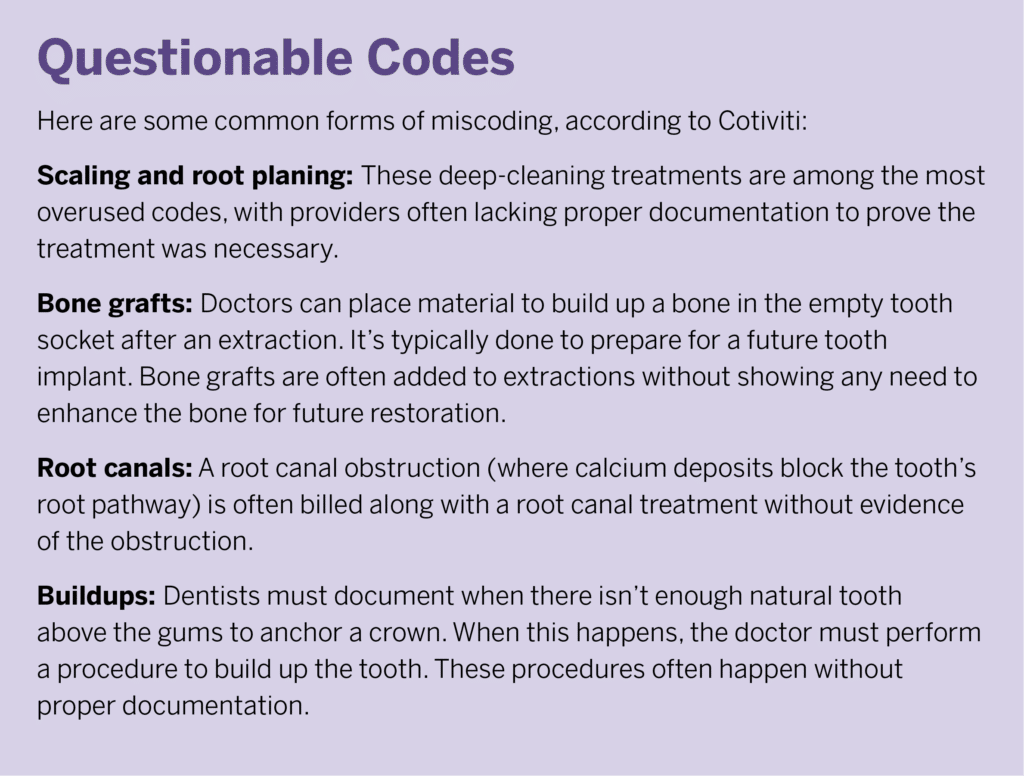
X-rays for a root canal. The ADA [American Dental Association] says that for a root canal, they recommend only one X-ray, and that’s all that should be paid for. That’s part of the coding of that particular procedure and service. But what often happens is, multiple X-rays will be taken. Let’s say they do five, and the billing office will send in four of those X-rays on a claim. Then a few days later, or the next week, they’ll send in the fifth X-ray and the root canal claim, thus getting paid for all five X-rays when they should have just been paid for one. That’s a really simple and direct example of splitting a claim. That’s not fraud because they did perform all of those services. It’s certainly wasteful. They’re billing in a way to skirt the intended definition of the root canal procedure and its payment recommendation by the ADA. A good payment integrity program can flag and catch [those billing codes] through technology because we see the other four X-rays and match it up with the root canal and X-ray.
Q
Why aren’t these coding issues caught by the insurers’ systems?
A
They don’t look. They look at one claim in isolation. I’m not aware of any dental adjudication systems that look across claims. So, you have to employ a comprehensive program, and I use program in the broad sense because you need people, processes, and technology to catch those kinds of things. Adjudication systems are primarily designed to take the services, apply the benefits, and determine the payment—not to catch billing errors. We have literally hundreds of schemes, or anomalies, that we can find through technology surfacing the claim to a dentist or a dental analyst for a review. There, they make a coding decision or a clinical decision based on the policy that we provide to a carrier or that they have in place already.
Q
What should an employer or broker look for in a good carrier payment integrity program?
A
It’s very important to have a comprehensive program that includes the policy that you’re going to administer. Then do that in a prepayment world, so you’re not in a pay-and-chase mode. You need to be able to demonstrate the value of that overall program, and you also must be able to provide consistent explanation for the policy or payment decisions that you make. Having a good payment integrity program is good for members and employers because dental is largely a coinsurance world. Finding unnecessary treatments is valuable to both the member and the employer, particularly for those that are self-funded.