
All Eyes on Healthcare
Federal healthcare laws and regulations enacted in recent years face serious obstacles in their goal of reducing medical costs.
Major changes to employer health benefits have been rare since their inception after World War II.
Landscape-altering laws have only passed about once a decade: the Employee Retirement Income Security Act (ERISA) in 1974, the Consolidated Omnibus Budget Reconciliation Act (COBRA) in 1985, and the Health Insurance Portability and Accountability Act in 1996.
After that, legislators and presidential administrations could not muster any significant healthcare laws or regulations until President Barack Obama’s 2010 Patient Protection and Affordable Care Act (ACA) dramatically changed the employer and individual markets. The law’s many impacts are well known to the insurance industry, notably establishing the state exchanges where the uninsured could purchase coverage with more protections than were previously available on the individual market.
While the ACA largely focused on increasing healthcare coverage, federal and state lawmakers and regulators today emphasize affordability, mainly by pushing for greater cost transparency. In theory, if patients know the price of healthcare services, they can shop for low-cost, high-quality care. Better-informed employers can also bargain with providers to control their expenses. But in practice, increased transparency has done little to reduce costs. People are paying more than ever for healthcare services, and the price for employers is increasing by about 9% annually.
While it has been nearly two decades since Congress passed truly landscape-altering healthcare law, lawmakers continue to legislate the issue. A major focus has been mandating increased transparency on the price of healthcare services in order to increase competition and reduce costs, though the data has proven difficult for consumers and plan sponsors to use.
Well-intentioned laws in other areas also face significant challenges. The No Surprises Act, included in the 2021 Consolidated Appropriations Act, prohibited surprise out-of-network billing for patients who had no choice on where to receive care. But it also established a fee arbitration system that heavily favors providers, driving up costs for insurers and consumers.
Both brokers and plan sponsors find themselves in a complicated benefits disclosure and reporting environment that requires increased time and creates a greater administrative burden. At the same time, new bills and rules continue to be introduced.
Transparency hasn’t inherently reduced healthcare costs because healthcare is not a consumer-friendly, shoppable market. Not all services are elective—in an emergency, people typically go to the closest, most convenient provider. Plan participants also use in-network providers without knowing if their organization offers the least expensive care. While cost information is now being made public, it comes in digital formats that can be impossible for consumers or employers to access and translate. Finally, people who like their doctors tend to stay with them, regardless of fees.
“The general philosophy behind this [focus on transparency] was that more information is better,” says Sarah Raaii, a partner at the law firm McDermott Will & Schulte who specializes in employee benefits. “The idea is good: plan sponsors can use information to oversee vendors and do an RFP to get more reasonable costs. But, frankly, we haven’t seen costs for health plans fall as a result of this; they are going to continue skyrocketing at unprecedented levels.”
Even if some of this legislation has been beneficial, it is not always easy for health plans and employers to follow. Complying with new benefits laws has become more challenging since the passage of the ACA, says Oliver Wyman senior advisor Kerry Finnegan, who has been in the employee benefits industry since the early 1980s. When ERISA became law, its details were largely included in the text itself. A few decades later, the U.S. Department of Health and Human Services issued hundreds of formal and final rules, notices, and guidance documents to implement the ACA. That approach has become the new normal as implementation of these new laws is sorted out over time.
Finnegan says “in the old days” employers and their consultants could establish 10-year plans to execute on new laws. Now, they must be nimbler because executive orders, a new presidential administration, or court actions overturn and amend legislation more quickly.
“Even though a law may be in effect, the environment that both brokers and plan sponsors find themselves in with the financial data, the disclosures, the administrative responsibilities has gotten more complicated,” he says. “I think employers are having a tough time knowing how to invest their time and effort and manage their risk in a fickler legislative environment. I think that’s one of the material fiduciary risks that employers have to assess, and brokers need to help them address.”
None of this has stopped legislators from introducing bills, or federal agencies from proposing new rules, to increase healthcare transparency or to otherwise change the market in ways that nominally benefit employers and employees. Some of these measures are now in place. While their advantages are real, so are their implementation challenges. Certain laws have even unintentionally created more paperwork and other issues for employers. Whether they will ultimately reduce costs and improve care remains to be seen.
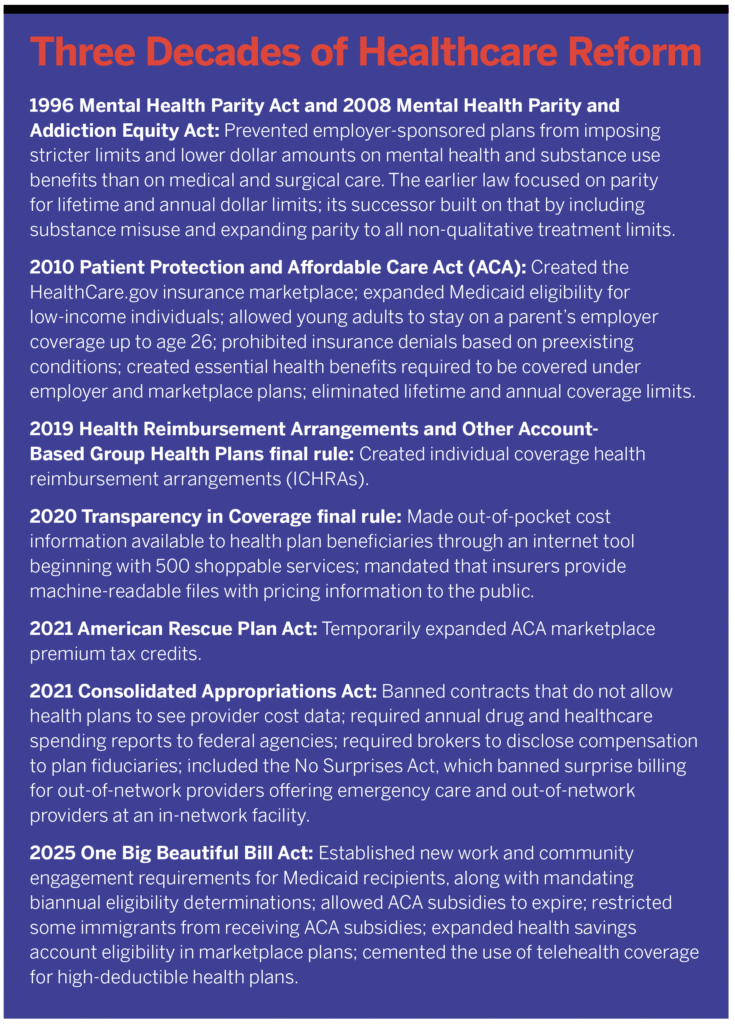
Here is a rundown of key healthcare-related bills and regulations from recent years and what has happened since their passage.
Mental Health Parity and Addiction Equity Act
This 2008 legislation is intended to ensure that benefits for mental health and substance misuse are no more restrictive than those for medical and surgical in employer-sponsored health coverage. The U.S. Department of Labor’s Employee Benefits Security Administration reviews plan documentation for compliance annually.
Particularly important are comparative analyses that group health plans must prepare of non-qualitative treatment limitations (NQTLs) on the extent and time frame of mental health or substance misuse treatment compared against medical or surgical care. Examples of NQTLs include prior authorization and medication step therapy.
Between 2023 and 2025, the Department of Labor agency requested 42 comparative analyses from health plans. None of the plans were fully compliant. Fourteen received formal letters saying their initial comparative analyses were insufficient, 25 had violations, and five received final determinations of noncompliance. Violations included exclusion of nutritional counseling in the plan, which would assist people with eating disorders; not covering applied behavioral analysis, a common autism treatment; not offering medication-assisted treatment for opioid use disorder; requiring higher prior authorization standards for mental health or substance use care than the plan does for medical treatment; and excluding telehealth for mental health therapy but not medical care.
Health plans struggle to meet their requirements under the law for many reasons. The dearth of mental health and addiction providers in most communities can make it difficult to provide an equal amount of behavioral health providers as are on the plan’s medical side. This is especially true in specialty areas like pediatric psychiatry. When these professionals are available in an area, many don’t take health insurance, further lowering the available pool of providers and the likelihood of equivalent care levels.
It may also be difficult for plans to obtain the information necessary for their comparative analyses. If a third-party administrator fails to provide a plan with information including a list of NQTLs, the written policies and clinical guidelines showing how the plans are structured for mental health and medical care, and the factors used to formulate terms and rules, a plan can’t create a full analysis.
“I think there’s still a tension and ongoing struggle to get that necessary information from service providers,” Raaii says. “Not having thought about it or not having addressed it in any way is hopefully pretty rare among employers.”
Raaii encourages employers struggling to obtain complete information for a comparative analysis to document all they do to make a good faith effort when the data isn’t available.
Another factor with the lack of apparent compliance could be the difficulty of knowing exactly what information is needed for a comparative analysis because there are no set guidelines. The law applies to every rule and policy that limits the scope or duration of treatment. In the analysis from 2023 to 2025, the Department of Labor reviewed 77 NQTLs among the plans.
The law has also undergone considerable transformation since its passage. Rules added in 2013 clarified how parity should be applied to different benefit classifications, separating them into categories including inpatient, outpatient, and emergency care, as these are often paid for with different types of copays and coinsurance. The comparative analyses weren’t actually added until the 2021 Consolidated Appropriations Act. In 2024, near the end of the Biden administration, the federal agencies in charge of the law finalized a new rule demanding enhanced data collection to ensure stakeholder compliance and added language that restrictions on access to mental health and substance use disorder benefits must be no greater than those for accessing medical or surgical benefits. But business groups sued, claiming the new data collection requirements were too burdensome for employers. The 2024 changes have been suspended under the Trump administration until the agencies can evaluate whether they are too onerous.
“Mental health parity is probably the poster child of employers throwing their hands up and saying, ‘If you guys can’t figure it out, how do you expect me to?’” Finnegan says.
The ICHRA Rule
Enacted in 2019, the final federal rules on Health Reimbursement Arrangements and Other Account-Based Group Health Plans set the stage for individual coverage health reimbursement arrangements (ICHRAs). ICHRAs—which the Trump administration has rebranded as CHOICE Arrangements—enable businesses to offer employees tax-free funds to buy their own health insurance plans through the marketplace or Medicare.
Particularly for small employers, ICHRAs can contain healthcare costs, or at least set a manageable budget. Instead of absorbing annual rate hikes on a group plan, ICHRAs enable employers to set a specific budget for each employee. Employers can also segment their workforce into different classes (e.g., part- and full-time, hourly or salaried, and management-level employees) and provide different allotments to each of those groups.
According to the HRA Council advocacy group, about two-thirds of small employers offering ICHRAs in 2026 previously did not provide any healthcare coverage, and about one-third moved to an ICHRA from the small-group market. This coverage is growing quickly among larger employers, too, the organization noted. More than 500,000 people were covered by an ICHRA at the beginning of 2026.
There are potential downsides to this approach. Finnegan notes that ICHRAs shrink the number of enrollees in employer health plans, which can increase costs for those who remain. The HRA Council reported that more than 20,000 employers are offering ICHRAs as a plan option in 2026.
“The whole concept of group insurance is to cast the risk across the broadest possible pool you can,” Finnegan says. “Creating subgroups like the ACA and ICHRAs is just breaking the insured population into smaller and smaller pools.”
I think there is an over presumption that transparency begets competition, which begets lower costs, and I don’t know that that connection is happening at all. If somebody tells a commercial plan sponsor, ‘You’re paying 250% of Medicare rates,’ what do they do with that information?
Kerry Finnegan, senior advisor, Oliver Wyman
ICHRA users who spend their money in ACA markets or for Medicare face the same problems as more traditional users of those systems. Premiums in the ACA marketplace rose more than 20% in 2026 and are expected to increase by another 15% in 2027. Meanwhile, major Medicare Advantage providers Humana, UnitedHealthcare, and Aetna have announced they are pulling plans from hundreds of counties next year due to reduced profitability.
“These programs are well-intentioned, I believe, but carriers on the individual market clearly are not keeping up with them,” Finnegan says.
Transparency in Coverage
The 2020 final rule on Transparency in Coverage requires group health plan carriers to disclose prescription drug pricing, the negotiated rates for in-network care, and amounts that can be paid for out-of-network services.
The goal is to enable consumers to make informed decisions on how to spend their healthcare dollars and to drive competition within the industry. But it, too, has faced challenges from its inception. Few hospitals initially complied with the data requirements, even though they faced fees for not doing so. A 2026 report found that fewer than half of all hospitals now post full cost information.
Even when the data is available, hospitals have different programs for reporting it and various algorithms for determining costs, making the information difficult to compare or to confirm its accuracy. Negotiated rates of insurers also include copays, coinsurance, and deductibles, making it more challenging for individuals to understand the actual cost for a particular doctor’s visit or medication. Finally, the machine-readable files hospitals must provide to insurers have been so large that employers had to hire vendors to translate the information into something remotely usable.
“I think there is an over presumption that transparency begets competition, which begets lower costs, and I don’t know that that connection is happening at all,” Finnegan says. “If somebody tells a commercial plan sponsor, ‘You’re paying 250% of Medicare rates,’ what do they do with that information?”
Cost information can be useful to negotiate reference-based pricing and direct contracting, remove outlying expensive providers from a network, or offer incentives for employees to choose high-quality, lower-cost hospitals and providers. But few of those things really move the needle toward reducing expenses in the system.
Increased cost and fee data availability also increase the risk of litigation for employers. “We’ve seen an uptick in cases where plan participants are trying to use transparency data or fee disclosure data to allege that the agreements that their plan sponsors have for the health plan are not reasonable,” Raaii says. “That they had agreed to exorbitant fees that were then passed on to participants. So, it’s unfortunately a double-edged sword.”
Lawsuits have been filed claiming, among other allegations, that employers paid too much for prescription drugs; that broker commissions for voluntary benefit plans were too high; and that broker and pharmacy benefit manager (PBM) fees were unreasonable.
“There’s a few different [allegations] that an employer did not uphold their fiduciary duty with respect to their health plan,” Raaii says. “It’s become a relatively recent thing where plaintiffs attorneys are shopping around and looking for opportunities to see what the most successful suits might be for this type of litigation.”
2021 Consolidated Appropriations Act
While this law was primarily meant to keep the federal government operating, it also requires employers to submit annual attestations to the Departments of Labor, Treasury, and Health and Human Services. In these statements, plans must provide healthcare cost and quality data including their total drug costs, most used drugs on the plan, hospital costs, and what they pay for specialty care. The law also mandates that brokers and consultants give compensation information to plan sponsors.
Finnegan says the law didn’t change much for many brokers who have, over time, come to provide their compensation information to clients. The challenge, instead, is how to describe that compensation properly. Under the act, any consultants who make more than $1,000 for providing broker services to a plan must provide a written disclosure to the plan fiduciary when a contract is made. The question is how to break down that compensation, according to Finnegan. The amount should include standard and supplemental commissions. Brokers also must provide information on the types of bonuses they receive (such as for client retention) and the formula to calculate those bonuses. Further complicating things, the Centers for Medicare & Medicaid Services has different rules for disclosure than do commercial carriers, and those rules are regularly modified, Finnegan says. So brokers working with commercial payers and Medicare Advantage have multiple rules to put in place for different clients.
The act also made pointed changes to PBM operations. These organizations must report spread pricing and drug costs and disclose rebates, fees, and discounts to plan participants. Different aspects of the legislation will go into effect throughout 2028. Full compliance for PBMs for group and employer-sponsored plans is required by January 2029.
Amendments to the CAA also clarified which service providers must give cost and fee information to plan sponsors. Aside from insurers, PBMs, and brokers, employers should receive that data from vision and dental plans, medical management companies, stop-loss insurers, disease management providers, and wellness management services, among a slew of other vendors.
“All employer plan sponsors should be asking for this information, and we’ve certainly advised our clients to ask from virtually all of their service providers,” Raaii says.
But her clients still have issues getting all of that information. Some vendors don’t think the updates apply to them. Others claim they have already given the material, even if it’s incomplete. She advises clients to ask for the information and document the vendor’s response.
“They can’t force the service providers to give them this information if they’re not willing or are really adamant it doesn’t apply to them,” she says. “I don’t think vendors are being unhelpful, but it seems like a lot of times we’re getting piecemeal information or incomplete information. It’s just good fiduciary hygiene to document they did their job in requesting the information. They can only ask so many times.”
The No Surprises Act (NSA), added to the 2021 CAA, may inadvertently be increasing employer healthcare costs. The bill addresses surprise billing, which can be extremely costly for patients who unintentionally receive out-of-network fees for medical care. For instance, if someone calls 911 and is automatically taken to an emergency room that is out of network, the hospital can no longer send the patient a bill for the fees their health plan didn’t pay.
The problem is the arbitration system used under the law, which drives up expenses for insurers and consumers. During arbitration, the insurer and the healthcare provider come to the table with prices they both think are fair for the outstanding charges. An arbitrator helps determine the final fee—but they must impose one of the presented offers. Arbitrators ruled in favor of the provider in roughly 85% of 2.5 million claims considered in 2025 alone, a New York Times analysis found, awarding the higher charge and solidifying the case for providers to remain out of network.
“The NSA is probably inadvertently associated with provider networks getting smaller,” says Jeff Levin-Scherz, population health leader for health and benefits for North America at WTW. “If you look at the health insurance plans that have a lot more exposure to provider groups that do a lot of the NSA arbitration, those have had higher rate increases than plans that had less exposure in recent years.”
One Big Beautiful Bill
One important component for employers in this 2025 law is the ability to cover telehealth and remote care services before meeting a plan’s deductible in high-deductible health plans (HDHP) with a qualifying health savings account (HSA). First enacted during the COVID-19 pandemic, this approach allowed plan participants with HDHPs to receive telehealth services without the traditional cost sharing required for services other than preventive care. But the provision expired at the end of 2024. Retaining this under the OBBB offers employers the ability to provide a range of services to their workforce knowing the care will be more affordable, particularly as plan deductibles rise.
“If employers offer, for instance, a virtual musculoskeletal program that includes a virtual visit with a physical therapist and exercises through an app, [without the extension] that visit might have needed to have cost sharing applied to it,” Levin-Scherz says.
To further support use of HSAs, the bill also enables these plan beneficiaries to pay direct primary care membership fees on a tax-free basis.
The NSA [No Surprises Act] is probably inadvertently associated with provider networks getting smaller. If you look at the health insurance plans that have a lot more exposure to provider groups that do a lot of the NSA arbitration, those have had higher rate increases than plans that had less exposure in recent years.
Jeff Levin-Scherz, population health leader for health and benefits for North America, WTW
Separately, the law reduces healthcare coverage and ACA subsidies for legal non-citizens. People applying for asylum, those with temporary protected status, refugees, and children under age 14 with pending adjustment of status are no longer eligible for Medicaid. They will also be removed from Medicare and be ineligible for ACA marketplace subsidies in 2027. Estimates show about 1.2 million lawful immigrants will lose healthcare subsidies and more than 1 million will lose coverage with these changes.
This is a challenge for employers because employer-sponsored coverage is supported by good public programs for those not in the employer mix, Finnegan says. Programs like Medicaid and Medicare cover people with low incomes and disabilities so employers don’t have those high-cost claimants on their rolls.
“All of a sudden all of these people aren’t eligible for coverage, and the vagaries of that for an employer are unrelenting,” he says. “For an employer who has 50% of their population as part time, that impacts them enormously.”
Further State and Federal Focus
A handful of other laws—and congressional decision-making—not aimed at employers have increased healthcare prices and destabilized the market. For one, Congress in 2025 did not extend the enhanced subsidies for ACA plans that passed in 2021 and were extended in 2022 by the Biden administration’s Inflation Reduction Act.
“What bills Congress chooses not to pass is important,” Levin-Sherz says. “The expiration of the enhanced marketplace subsidies has led to a pretty substantial decrease in the number of marketplace plans and higher premiums in those plans.”
A KFF survey released in October 2026 found that the number of people enrolled in the ACA marketplace dropped from 21.8 million in 2025 to 19.2 million by February of this year. Premiums for remaining enrollees increased by an average of 58% after the tax credits expired.
Having fewer people in the marketplace puts more pressure on organizations to cover them with employer-sponsored coverage. Higher marketplace premiums could also give pause to employers considering ICHRAs to cover some, or all, of their workforce. These could be employers looking to move away from group plans or to cover currently uninsured populations.
Meanwhile, a couple of bills moving through Congress still aim at transparency as a solution to high costs. The Patients Deserve Price Tags Act introduced in the Senate in 2025 would require hospitals and insurers to post actual upfront pricing for services. It would also give self-funded employers complete access to their claims data and expand price transparency rules to additional providers including labs, imaging centers, and ambulatory surgical centers. The bill has been on the Senate legislative calendar since approval in July by the Health, Education, Labor, and Pensions Committee. A corresponding House bill was introduced in September and sent to several committees for consideration.
The Lower Costs, More Transparency Act in the House would also require clearer price reporting that would be more understandable to consumers. It requires PBMs to report information on their spending, fees, and rebates. The bill was unanimously reported out of the House Energy and Commerce Committee in July.
State legislatures have also been working indirectly on reducing costs. Indiana, which has some of the highest hospital prices in the nation, in 2025 passed legislation that targets its five main nonprofit hospitals, capping pricing for employer-based health plans at 260% of Medicare rates. According to a 2024 report by the Indiana Department of Insurance, several nonprofit hospitals were charging from 324% to 376% of Medicare rates for outpatient services. In 2017, Oregon legislators passed a law that caps rates for the state employee health plan to double that of Medicare rates that began phasing in in 2019. A 2025 law in Washington caps rates at 200% of Medicare costs for public and school system employees.
Colorado passed “name and shame” legislation in 2023 requiring hospitals to post their Medicare rates alongside their commercial prices. Vermont enacted legislation in 2025 that requires the state’s healthcare regulator to use Medicare benchmarks in setting rates for commercial payers, starting no later than 2027.
“Clearly, there’s been a lot of work in various states, and that does matter for employer health plans,” Levin-Scherz says.