Propped-Up Policy
The ICHRA market will grow in coming years, but legislative fixes are needed, employee benefits executives say.
The market for individual coverage health reimbursement arrangements (ICHRAs) is likely to grow in the next five years, though by how much remains subject to debate, according to employee benefits executives.
But Congress will need to step in for the market to reach its full potential.
ICHRAs are a regulatory construct established in 2019 by the Departments of Treasury, Labor, and Health and Human Services. The construct allows employers of any size to offer employees tax-free funds—known as a defined contribution—to buy individual health insurance and to create different employee classes (e.g., full-time or part-time) for the purpose of offering different benefits to those populations within compliance guidelines. The rules also put Affordable Care Act (ACA) safe harbors in place so large employers—defined as having more than 50 employees—may avoid financial penalties mandated by the ACA, such as per employee per month fines for failing to offer both affordable ($4,350 fine) and minimum value ($2,900 fine) coverage. As a result, ICHRAs are individual plans under a group health plan umbrella.
As healthcare costs steadily rise, the pressure to find alternative coverage solutions is growing for both employers and brokers. A 2025 McKinsey survey found that over half of 1,900 employers expect healthcare cost increases beyond inflation in 2026.
Members of The Council of Employee Benefits Executives (CEBE), in a recent survey, offered cautious optimism about the individual coverage health reimbursement arrangement (ICHRA) market as one of the potential solutions. Nearly 90% offer or intend to offer ICHRAs in the next three years and most expect significant market growth over the next half-decade.
ICHRAs are a regulatory construct from several federal agencies. Codifying the arrangement in law would provide ICHRAs with greater stability and predictability in group insurance markets, CEBE members say.
Brokers and employers see ICHRAs as one way to manage continuously rising healthcare costs, which employers are increasingly struggling to bear the weight of in employee group health plans.
Employers’ Financial Pressures
A 2021 survey by the Kaiser Family Foundation and the Purchaser Business Group on Health found that top executives at nearly 90% of 302 large employers believed the cost of providing health benefits would become unsustainable in the next five to 10 years. Eighty-five percent said the government will need to intervene to provide coverage and contain costs. Meanwhile, premiums for family coverage have risen an average of 26% since that survey was conducted.
The private insurance market, which includes employer-provided coverage, endures far worse cost increases than public, government-funded insurance programs. A RAND study found that private insurance in 2022 on average paid hospitals 254% of the cost to Medicare for the same inpatient and outpatient services. Stretched particularly thin are middle-market employers, which employ 100 to 2,000 people and generate roughly one-third of private sector GDP, according to the benefits administration firm Staff Benefit Management Administrators. These companies cannot always command enterprise-level pricing or negotiation tactics, but they have complex compliance responsibilities and the need to attract and retain key talent.
Are some employers exiting the group health insurance market in favor of individual markets because they face steep renewal rate increases and cannot continue to offer comprehensive and affordable health benefits? Anecdotally, yes.
Employers with more than 50 employees are the fastest-growing cohort offering ICHRAs, the HRA Council said in its 2025 report on trends among more than 13,000 U.S. businesses offering defined contribution coverage. Last year, approximately 10% of surveyed employers transitioned from traditional group insurance to ICHRAs.
However, the majority of ICHRA enrollees stem from companies that are offering health insurance for the first time. The HRA Council reported that 48% of employers selecting ICHRAs previously did not provide healthcare for their employees.
ICHRAs are one example of an alternative plan design that puts less financial pressure on plan sponsors because of the defined contribution nature of the benefit, but these arrangements have not overtaken the group health insurance market in popularity and flexibility for reasons including regulatory hurdles, lack of employer and employee education, and individual market stability. Between 350,000 and 700,000 employees and their dependents are currently enrolled in ICHRA coverage, according to the Employee Benefits Research Institute. That equates to between 0.19% and 0.38% of the 180 million people who have employer-sponsored coverage. The Congressional Budget Office now estimates that 2 million workers will participate in ICHRAs by 2032.
Individual Market Focus
Defined contribution solutions are not a new idea. So why are group health insurance brokers focused on individual market solutions now?
Two market conditions have encouraged brokers to reassess how they manage client risk profiles: the rise in high-dollar claims and the state of the individual market (prior to 2026).
Premium coverage increases impacting the private insurance market are driven in part by the rise in catastrophic claims, fueled by clinical advancements and curative yet costly treatments. These claims intensify financial pressure on self-insured employers, which in some cases are navigating a risk profile too large and complex to operate effectively within a traditional group insurance model.
In its most recent analysis of annual high-cost claims and injectable drug trends, stop-loss provider Sun Life noted that $1 million stop-loss claims increased by 29% in 2025 and 61% over the last four years. The highest single claim reached $12.7 million. Eighty-eight percent of employers are likely to experience a stop-loss claim in any given year, according to Sun Life.
Meanwhile, individual market conditions have generally improved over the last several years when measured by the balance of the risk pool, coverage options, and market competition. In 2025, there were a record 24 million enrollees.
According to the HRA Council report, ICHRA adoption remains highest among the 26–34 age group, which is typically a lower-risk, lower-cost population. This demographic prefers budget control and health plan optionality, as these workers typically have lower coverage needs. Some may be purchasing coverage for the first time if they age off a family health plan. Continued participation by this age group could signal future premium rate consistency and risk pool stabilization.
In the coming plan year, 312 health insurers will participate in the individual markets. That will be a 46% increase in participation since 2022, but a slight decline from the 320 that participated in 2024. The general uptick is propelled by shifting carrier product and network strategies. For example, UnitedHealthcare is adding coverage in more counties within the 30 states it already serves.
Other carriers have identified ICHRAs as a growth opportunity. Benefits brokers who participated in a Council policy survey noted that certain carriers are beginning to offer off-exchange health plans—ACA-compliant major medical plans that can be purchased directly from an insurer using an ICHRA. These plans are designed to feel more like a group health plan in terms of benefits and provider networks.
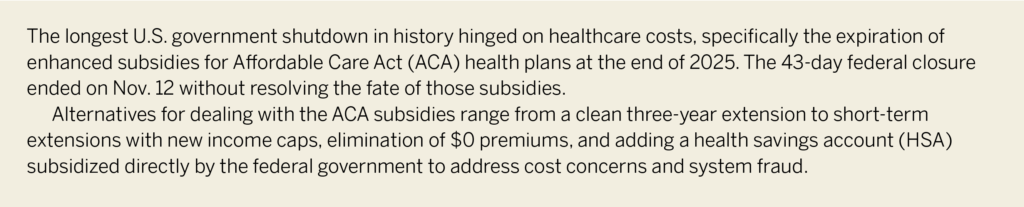
That growth mindset will be challenged in 2026, though, for those insurers participating in the ACA marketplaces. Enhanced ACA subsidies (which expired at the end of 2025 but could be revived by Congress), general market uncertainty, and rising costs present significant headwinds to carriers that have invested in this market segment over the past several years. That uncertainty spurred some insurers—notably Aetna—to withdraw from the individual markets altogether in 2025, citing financial underperformance.
The median proposed premium increase in 2026 for individual market coverage is 18%, which is the largest rate change insurers have requested in the last seven years, according to KFF. In their 2026 rate filings, which are prepared by insurers and submitted to state and federal regulators ahead of the upcoming plan year, ACA marketplace insurers indicated that they plan to charge four percentage points more, on average, because they expect healthier individuals to drop coverage without the promise of enhanced subsidies. About 22 million, or 90%, of individual market enrollees receive some form of subsidy, which has acted as a shock absorber for higher plan costs.
ICHRA growth will depend in part on the state of the individual insurance markets. It’s worth noting that employees participating in an ICHRA are not eligible to receive ACA subsidies.
Why ICHRAs?
Rising costs have put enormous pressure on employers’ healthcare budgets over the last few years, to the point where first-line defenses are no longer as effective and the pressure to find alternative solutions is undeniable. One leading indicator is the rise in employers moving to a self-insured model, which is typically viewed as a cost-control strategy that provides control over healthcare spending and plan design. According to KFF, 67% of workers with employer-sponsored insurance are enrolled in self-funded plans. Additionally, a 2025 McKinsey survey of about 1,900 employers revealed that more than 50% expect healthcare cost increases beyond inflation in 2026. The survey also found that 51% of respondents increased employee cost-sharing over the last two years to redistribute some of the financial burden. Those efforts have now slowed, or even reversed, as 34% of employers indicated that high out-of-pocket costs are a key pain point for employees.
McKinsey reported that 35% of employers plan to switch brokers in the next one to two years for reasons including access to a variety of cost-curbing solutions. Forty-nine percent of surveyed employers would like brokers to provide an overview of broader, cost-saving, health plans and offer more proactive help with managing healthcare costs.
Brokers know that employers will take their business elsewhere if they cannot deliver successful cost containment solutions. That has motivated brokers to look outside of the traditional group health insurance market at alternative plan designs, like ICHRAs, to serve certain employee populations.
McKinsey and The Council of Insurance Agents & Brokers in 2025 partnered on a survey of 128 employee benefits brokers and consultants. It showed in part that brokers are responding to employers’ pain points by implementing a wide range of cost containment levers. Eighty-four percent of brokers said cost containment and healthcare spend management strategies are their top priorities. While ICHRAs represent one strategy, they are typically used in concert with other solutions aimed at lowering employers’ overall healthcare spend.
ICHRAs can increase cost predictability associated with group benefits, as they enable employers to set a fixed, tax-free monthly allowance for employees to use on premiums and certain healthcare expenses. These arrangements also allow employers to forgo selecting and managing a group plan—or multiple group plans— for their employees, though ICHRAs have their own specific administrative, reporting, compliance, and plan participation requirements.
Rapidly rising healthcare costs fueled by inflation, market consolidation, evolving regulatory and compliance requirements, and a lack of price transparency are forcing employers—and their broker partners—to navigate a national economic challenge.
The Council policy survey and other industry research reveal ICHRAs’ potential as well as their current drawbacks. The CEBE advisory board thinks it is worthwhile to advocate for ICHRA codification under federal law, as codifying the rules would provide more stability and predictability for these solutions in the group insurance markets.
The Council of Employee Benefits Executives notes that there is no one approach to ICHRAs that works for all employers. What makes sense for small businesses may not for larger companies due to their workforce size and dynamics, overall administrative burden, and additional compliance requirements. Statutory authority would provide a clearer path to address emerging challenges with ICHRAs as well as avoid gaps in policy and implementation.
Without codification, this regulatory construct could eventually be challenged in court, especially following the Supreme Court’s ruling in Loper Bright Enterprises v. Raimondo, which weakened the doctrine of court deference to federal agencies’ reasonable interpretations of ambiguous laws.
Still, most of the employee benefits executives surveyed already use ICHRAs to stabilize financial risk for their clients. Individual market dynamics, labor market pressures, and employer sentiment regarding rising health costs are all factors to watch as to whether ICHRAs gain traction among larger employers.