Normalizing Menopause Benefits
Q&A with Isha Vij, Senior Vice President, Employer Growth, Maven Clinic
Maven is a virtual digital health platform that provides benefits for women and family health for more than 2,500 organizations in 175 countries.
Its newest program, for menopause and midlife care, is part of a growing number of platforms packaging products aimed at individuals in this stage of life so they can access care ranging from pelvic floor health to nutritionists. Vij discusses what a menopausal benefits package looks like and why all employers should consider midlife health policies for their employees.
Q
Maven was established to offer employee benefits to birthing people. How did it begin offering menopause support?
A
We were launched 12 years ago because our founder and CEO [Kate Ryder] realized there was very little support for individuals as they navigated pregnancy. She created this platform to give people access to all the resources, providers, and insight for that stage of life. It was through members’ encouragement that we expanded into other programs like fertility and family building. Then, a few years ago, we noticed that many of our members were talking to providers on our platform about symptoms related to menopause, perimenopause, and postmenopause. Our providers, the employers we’re working with, and members encouraged us to launch a program specifically designed for people as they navigate menopause and midlife health. We started it in 2022.
Q
Why should employers be thinking about menopause health?
A
It can be such a long period of time that this is impacting women in the workplace, and this kind of program makes it possible for them to not only show up to work, but to thrive. It was natural for many employers to add because of the scale at which it impacts their workforce. The number of women entering menopause every year is about 47 million globally. That is such a huge number of people, but only about 15% of employers in the United States offer menopause benefits.
Employers that have put out ambitious goals of supporting female employees—some striving for 50/50 gender parity at the executive level—can’t achieve that sort of diversity and inclusion of senior women in the workforce without ensuring they’re supporting them when they are experiencing such significant health-related changes in this stage of life.
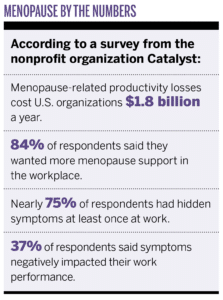
And it makes good business sense. Over one-third of employees have considered stepping back or leaving their jobs due to symptoms related to menopause. If employers have invested in bringing top talent into the organization, it makes sense to ensure they are retaining that talent.
Q
You mentioned only about 15% of employers offer menopause benefits. How has uptake been with your program?
A
It’s our fastest-growing program, with membership [doubling] year over year. We’re seeing small organizations bringing Maven on, along with huge organizations that have a tremendous global footprint, like Microsoft and Sanofi. We even have partnerships with health plans like Blue Cross Blue Shield of Michigan. It’s so clear that this is an area that has been underserved, and the impact of not supporting populations that are navigating this is tremendous.
Q
Is uptake so high, in part, because of increased awareness of menopausal issues on social media and in the zeitgeist?
A
Menopause used to be a taboo topic. A shift has started to happen where a lot more people are talking about it. Celebrities are talking about it. There’s a lot of online communities that are growing, medical experts who are talking about it. Because women are starting to realize that they’ve been overlooked and under supported. It’s time to ensure that there are really transformative and innovative health solutions for these individuals.
Q
Why is it important to package menopause into one benefit program instead of allowing plan participants to use their traditional benefits?
A
Organizations bring on programs like Maven because there isn’t a great alternative. If you talk to a person navigating these symptoms, it’s a double whammy. There’s a lack of education for the individuals experiencing it—80% of women say they never learned about menopause in school, in sex ed, health, or science classes. They are going to doctors hoping to get answers. But, unfortunately, they’re not getting help there either because OB-GYN residents indicate they’re barely comfortable discussing the treatment of menopause. So where do you turn?
Q
Menopause encompasses many symptoms. What providers do you have to care for the various issues people deal with during this time?
A
We have more than 30 different specialists available on the platform. We strive for members to connect with a provider within a couple of hours of when they need them because we know some of these symptoms are particularly challenging and acute. We have developed a robust network of providers on a global scale that are well-equipped, well-versed, and knowledgeable in these areas.
It’s not just ob-gyns. The reason we’re able to support members so quickly is because we’re treating them in a really holistic way. [Among the other] providers that we see most often that individuals are engaging with outside of ob-gyns are pelvic floor therapists. We know that pelvic floor exercises and pelvic floor health are incredibly important, and [therapists are] hard to find for people navigating this phase of life. Nutritionists are incredibly popular, as are sexual health providers. Career coaches are popular because so many women are navigating the challenges of being able to talk openly in their workplaces about their menopause-related symptoms. We can help them navigate their sleep, their diet and exercise, mental health, and career. We can also provide symptom relief and support, whether it’s through HRT [hormone replacement therapy] or other prescriptions.
Q
Do you offer services aside from healthcare?
A
We do. We have manager training guides. We have HR guides. We do webinars for employees and managers on navigating these symptoms. People look to us for this because there’s no point reinventing the wheel. Companies can learn from what other organizations have done well, where they’ve seen that impact. They can learn from companies that have invested in their talent, retained it, kept productivity high, and reduced absenteeism.
Menopause used to be a taboo topic. A shift has started to happen where a lot more people are talking about it. Celebrities are talking about it. There’s a lot of online communities that are growing, medical experts who are talking about it. Because women are starting to realize that they’ve been overlooked and undersupported.
Q
Do you track results from plan participants? If so, what have you seen?
A
In Maven’s menopause and midlife health program, 93% of our members report experiencing a reduction in severity of at least one of their menopausal symptoms. They’re seeing and feeling those health outcomes and symptom relief. About 27% of members say this has been so dramatically helpful that they are going to be able to stay in the workforce longer.
When people are well-rested and well-fed, when they’re moving their body, when they have the right providers in place to take care of their mental and physical health, that’s when they’re able to show up to work and lead teams, lead initiatives, lead the things that are going to be transformative for their organization. We hear over and over again from our members that there is such a dramatic improvement in their symptom management that it’s allowing them to stay on the same trajectory that they were on before menopause. They don’t feel like they have to transition to another role because they have brain fog and are struggling to communicate. They are still the same person they’ve always been; they just need to be cared for a little bit differently. And organizations are retaining their senior women leaders. They’re not going through the process of finding and replacing that talent when they had the talent that they needed in the first place.
Q
Do you provide care for men in midlife as well?
A
We do support males as they’re navigating midlife health. There’s a ton of resources and providers specifically for males who have their own changes in midlife. That could be through mental health coaches, career coaches, and urologists, which are incredibly frequently sought out by men in this program.
This program is for any employer that has a population that is going to be entering midlife. Even the perimenopausal phase, which can start as young as mid-30s. I think it is not well known that perimenopause can start so early for individuals. People think about menopause as a health-related event that happens in your 50s and 60s. But it’s not. It starts much younger than people know, and supporting employees earlier on is just going to make sure your employees have the support they need as they continue down that trajectory.
Q
If an employer doesn’t want to participate in this kind of program, what can it do to support people during this phase of life?
A
There’s so much opportunity for organizations to do something, because most are doing nothing. The first thing they can do is make the workplace a space where employees can talk about menopause openly and make it OK to ask for help and for accommodations. That could be flexible work environments or flexible working hours. Even being mindful of things that can seem small, like the temperature in the office. Are there different parts of the office that are temperature-controlled to help people work more comfortably? For menopausal women experiencing hot flashes, there could be a cool area in the office that folks can use and employers can normalize that. It doesn’t have to be everywhere, maybe just one conference room.
That kind of thing comes at almost zero cost. Allowing people to talk about it, to offer support groups or create an employee resource group where people can talk openly about what they are experiencing. Leaders really set the tone, especially the senior-most leaders across an organization. If they are more conscious about it, and more vocal about it, it can have a tremendous impact on the culture of the organization. Employers can also train managers to listen to women dealing with this and be flexible when possible. There are a lot of small things employers can do that would have a tremendous impact on the organization.